
What is a Turnkey Sportsbook Solution? Costs, Features, and Launch Timelines
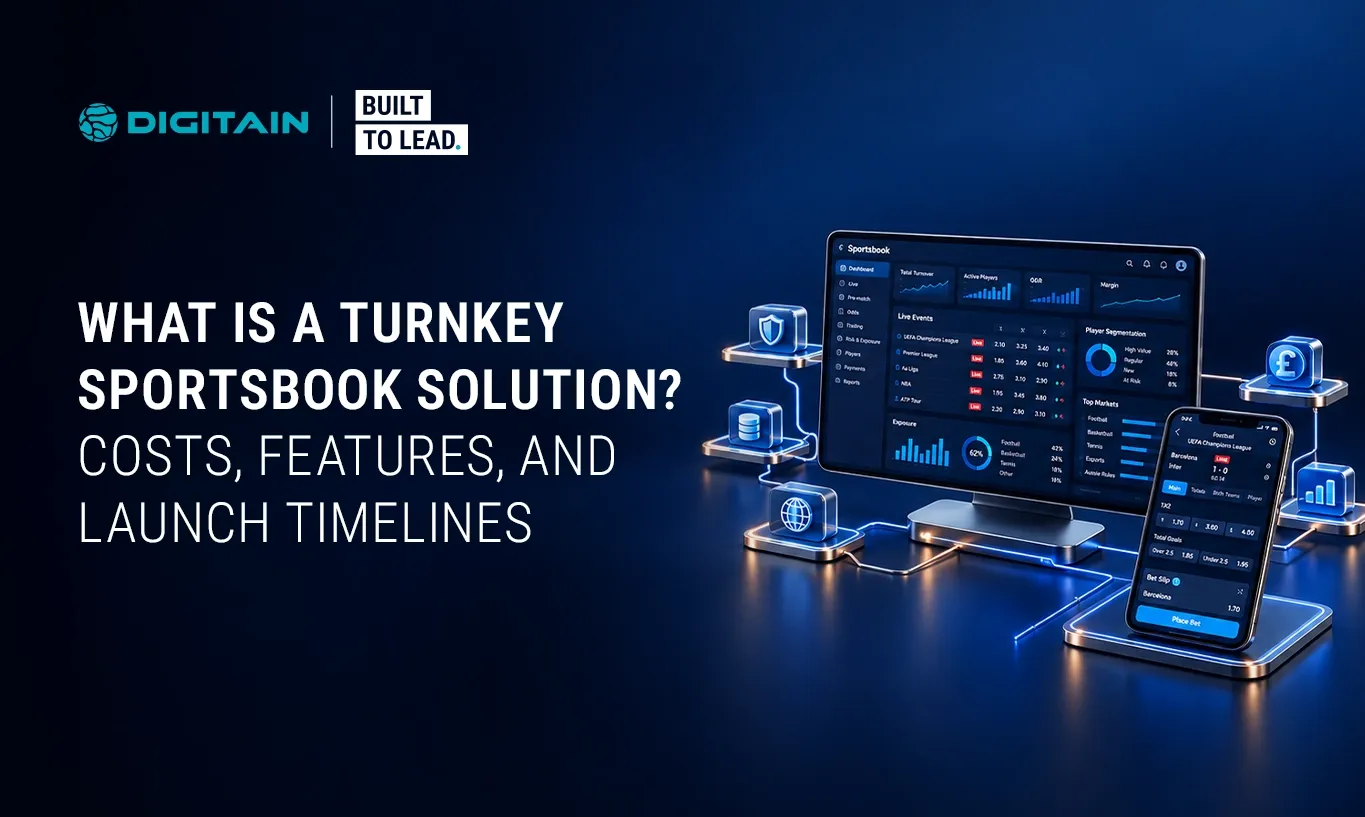
A turnkey sportsbook solution is a pre-built platform that gives operators the technology, data feeds, and operational tools needed to enter the market. The platform is tested and ready for configuration, but the operator must complete all applicable licensing, regulatory, and compliance requirements before going live. Your team applies the finishing touches, satisfies regulatory obligations, and launches.
In this guide, you will learn what is included in a turnkey package, how much it costs, how long it takes to launch, and how it compares to other operational models.
What is Included in a Turnkey Sportsbook Platform?

Below, you will see what a turnkey sportsbook includes. Use the sub-sections below to see how each part fits together.
Core Software and Platform
A turnkey sportsbook starts with a core platform that runs player accounts, wallets, permissions, and integrations. It links your site and app to odds feeds, payments, game content, and marketing tools. Most platforms are modular, so you can launch with a focused setup, add features over time, and open new markets as licensing allows.
Player Interface
Players expect a fast site that works well on any screen. A turnkey setup includes a responsive web and mobile front end, with optional native apps. You can customise the betslip, menus, and layout, and localise language, odds formats, and content.
Good design helps players find markets quickly, place bets with fewer taps, and return more often.
Admin Panel and Controls
Operators need control without extra effort. The admin panel gives you dashboards for player activity, bet settlement, liabilities, payments, and campaign performance. You can segment players, set limits, and review risk flags. Reporting tools export the data you need for finance and licensing audits.
Odds Feed and Data Providers
Turnkey sportsbooks link to several odds and data feeds. This widens markets, improves price accuracy, and strengthens coverage of local leagues. If one feed misses an event, another can step in. Feeds supply fast price updates, player stats, and event data for pre-match and live betting. The platform merges these inputs and sends a single view to your site and app.
Pre-match and Live Odds
Pre-match prices set the stage, live betting drives the pace. A turnkey sportsbook includes both. You can offer match results, totals, handicaps, player props, and specials for pre-match. Live betting adds partial cashout and quick settlement. The system grades bets at speed and updates exposure in real time. The result is better liquidity and more engaged customers.
Sports Coverage
A strong package covers sports leagues and tens of thousands of live events each month. That range keeps your content fresh across seasons. It also lets you lean into regional sports with loyal fan bases.
Risk Management and Exposure Control
Trading teams need clear controls. A turnkey sportsbook includes watchlists, bet pattern alerts, automated settlement logic, and fast suspension rules. You can flag sharp players, auto-limit risky markets, and quarantine bets for manual review. Pre-set profiles help you manage multiple countries or brands from a single place.
Auto-trading vs Manual Trading
Automation speeds up pricing and settlement. Human traders fine-tune the edges. A good setup blends both. Auto-trading handles routine pricing and settlement for high-volume markets. In most regulated jurisdictions, the operator remains responsible for assessing market and event risk before enabling events for customers. Automated systems support that process but do not replace the operator's duty to review. Manual trading steps in for sharp action, local derbies, or complex specials. The aim is fewer mistakes during busy periods.
Limits, Margins, and Exposure Control
Managing financial risk protects margin. You set staking limits by player, market, or event. You set target margins and adjust by sport or league strength. Exposure tools track liabilities in real time and cap risk on hot matches. With clear rules, you protect margin without blocking good traffic.
Payout Management
Payments can make or break conversion. A turnkey package supports cards, bank transfers, and local payment methods where permitted by the regulator in each target market.
Currency support depends on the jurisdiction. In most regulated markets, only local currencies are permitted. The platform can support multiple currencies where regulations allow, but operators must confirm which currencies and payment methods are approved in each licensed market. You can ringfence funds, split balances between bonus and cash wallets, and report on settlement times by method.
Fast payouts build trust. You can define withdrawal rules and payout speeds per method. Reporting tools support finance teams with settlement tracking.
Customer Support Tools
Support teams need the right view at the right time. The admin panel includes full player profiles, bet histories, payment logs, and communication records. You can issue goodwill credits, resend verification links, and update limits within permissions. Integrated chat and ticketing systems cut handling time.
Turnkey vs White-Label Sportsbook

These are two of the more common operational models, though many variations and hybrid arrangements exist. The right structure depends on your licensing position, commercial objectives, and the level of operational control you need.
One point applies to both models: in regulated markets such as Great Britain and Malta, the licence holder carries full responsibility for the operation. Regulators expect the licensed entity to maintain control over compliance, player protection, and commercial conduct regardless of which technology or service arrangements are in place.
A turnkey sportsbook gives you your own platform. You operate under your own licence in your chosen market. You control payments, risk rules, and marketing, with help from the provider where needed.
In a white-label arrangement, the operator typically uses the provider's platform and may benefit from the provider's B2B licence and existing market infrastructure. The operator still needs to understand its own regulatory position and obligations. In the context of licensing, the licence holder is the entity that holds the operating licence. B2B licence holders (providers) supply technology and services but do not hold the operating licence on the operator's behalf. Even in a white-label model, the operator may need its own licence depending on the jurisdiction and arrangement.
Below is a comparison of both models. These represent common configurations. Actual arrangements may differ based on jurisdiction, provider, and commercial agreement:
| Area | Turnkey Sportsbook | White-label Sportsbook |
| Licence Holder | The operator holds the gaming licence for the target markets | Runs under the provider licence in supported markets |
| Brand Control | Full control of brand, domain, site, and app journey, content, and promotions | Branded front end with fixed templates and pre-set flows |
| Tech Control and APIs | Dedicated or segmented setup with wide API access for third-party tools and custom features | Shared platform with limited API access and fixed modules |
| Customisation Level | Deep configuration of features, odds views, bonuses, and player journeys | Theme changes and basic settings with a standard feature set |
| Payments and Merchant Accounts | Operator uses own merchant accounts, picks PSPs and local methods, and receives direct settlements | Provider controls the cashier and merchant accounts with fixed payment routes |
| Risk and Trading Control | Operator sets limits, margins, and exposure rules with a mix of automated and manual trading | Provider manages trading with standard limits and rules |
| Data Access and Ownership | Full access to player, payment, and bet data with exports for BI and finance | Limited access with aggregated or standardised reports |
| Compliance Duties | Operator leads KYC, AML, and responsible gambling under local rules, using provider tools | Provider handles most duties; operator follows set procedures and marketing rules |
| Cost Model | Set up fee plus monthly platform fee, with optional revenue share | Lower setup with a higher revenue share model |
| Ongoing Costs | Platform, hosting, support, odds feeds, payment costs, and marketing tech | Bundled within the revenue share plus payment method fees |
| Growth Path | Easy to add markets, brands, and features without moving platform | Suits market testing; migration often needed as volumes rise |
| Reporting | Real-time dashboards, custom reports, and finance-ready exports | Standard reports with fewer custom views |
| Marketing Control | Full control of CRM, bonuses, affiliates, and channels within local rules | Provider sets most controls; operator focuses on acquisition and front-end content |
| Exit or Migration | Stay long-term and expand on the same stack | Often move to turnkey or a custom build once scale is reached |
Cost of Launching a Turnkey Sportsbook
How much does a turnkey sportsbook cost? Costs vary by market, feature set, and traffic plans. Think in layers rather than a single figure.
The setup covers environment build, integrations, and initial custom work. Ongoing fees cover platform access, hosting, support, and updates. You can pay a flat monthly fee, share revenue, or use a hybrid. New operators often start with a lower fixed fee and a higher share, then switch to a fixed fee as volume grows.
Other costs:
- Licensing costs include application fees, local legal support, and annual renewals.
- Payment processing costs include method fees, chargebacks, and currency exchange.
- Marketing tools include CRM platforms, email and SMS costs, affiliate tech, and creative production.
- Sportsbook startup costs also include trading staff, translations, and customer support coverage.
Smaller markets with one brand and a modest sports focus may need a low to mid five-figure range for setup, then a monthly fee that scales with volume. More custom work requires a six-figure setup fee. Regulated markets with strict testing raise costs through certification and audits.
How Long Does it Take to Launch a Turnkey Sportsbook?
Turnkey sportsbooks often launch in 6-10 weeks once contracts are signed. Complex markets or customisation levels can push timelines to a few months. A custom build from scratch can take up to 12 months.
Licensing timelines vary by jurisdiction. Regulatory approvals, including licence applications, certification, and compliance sign-off, can add weeks or months depending on the jurisdiction and should be planned in parallel with platform setup. Custom design and front-end work add time. Payment approvals can take days or weeks based on the method and bank partners. Content localisation and translations take time if you serve multiple languages.
Coordination across legal, trading, and marketing teams can speed things up when clear owners are named early.
Turnkey gives you tech on day one. You configure, localise, and go live once all regulatory requirements are satisfied. A custom build needs full product design, engineering, testing, certifications, and operations playbooks. The risk and cost rise with each new module. Below is a sample timeline:
Week 1: Discovery, scoping, contracts, and kick-off.
Weeks 2-3: Platform setup, domain and hosting, branding, initial integrations.
Weeks 3-5: Payments setup, KYC and AML workflows, odds feeds, risk profiles.
Weeks 4-6: Content loading, localisation, bonus engine setup, CRM journeys.
Weeks 6-8: Soft launch, test traffic, support training, final fixes.
Going live: Marketing push, partner campaigns, live trading playbook in action.
Note: This timeline is indicative and assumes that all required regulatory approvals and licences have been obtained. Where regulatory approval is required at any other stage of the project, the associated approval period should be considered separately, as regulatory authorities typically do not provide fixed response timelines.
Licensing and Regulatory Requirements for Turnkey Sportsbooks
With a turnkey setup, the operator holds the licence in the target market. The provider supplies the technology and supports audits, but the operator carries full regulatory responsibility. In other operational models, the regulatory position depends on the specific arrangement and jurisdiction, but regulators such as the UKGC and MGA expect the licensed entity to maintain control over compliance, player protection, and commercial conduct.
Common licensing jurisdictions include Malta and the UK. Licences in countries such as Romania and Serbia are issued by national or jurisdictional gambling authorities with full regulatory standing. Each jurisdiction sets its own rules.
KYC confirms identity and age. AML focuses on source-of-funds checks and suspicious activity reporting. Responsible gambling tools cover deposit limits, reality checks, time-outs, and self-exclusion. Secure data handling and integrity controls sit in the background. Your platform should make these controls visible and easy to manage.
Regulators ask for regular reports on deposits, withdrawals, disputes, and responsible gambling measures. They expect fast responses to data requests and clear audit trails. The right provider gives you reporting templates, export tools, and guidance on updates. Digitain works across multiple regulated markets and supports partners through these cycles.
Is a Turnkey Sportsbook Suitable for New Operators or Only Experienced Ones?
New operators pick turnkey to launch faster and reduce technical risk. It gives you proven odds, smart risk tools, and payments that work in your market. You focus on brand, marketing, and customer care, while the provider handles platform stability and updates. That balance helps you learn the business without having to build every part from scratch.
But you still need to understand your market and player base. A good provider will share guidelines and training, but day-to-day decisions depend on you.
Pros and Cons of Turnkey Sportsbook Software
These are the main advantages and trade-offs of turnkey sportsbook software. Use it to weigh speed, cost, control, and long-term fit for your operation.
| Pros | Cons |
| Fast launch with a proven stack, proven odds, and an experienced support team | Less customisation than building from scratch |
| Lower upfront cost and lighter early cash needs | Revenue share can press margins as volumes grow |
| Operational tools that help operators implement market-specific regulatory requirements including KYC, AML, and responsible gambling | Must work within the provider’s modules and release schedule |
| Wide sports coverage and flexible payment options help acquisition and retention | Dependency on the provider’s roadmap and support response times |
The best way to manage this is to choose a provider with strong account management and a good track record.
Why Choose a Turnkey Sportsbook Instead of Building Your Own?
Building your own sportsbook means hiring developers, traders, data scientists, payment experts, and compliance staff. You need to connect feeds, test settlement at scale, and pass certifications.
Buying a turnkey platform gives you that groundwork from day one. You still own your brand, control your risk rules, and choose your payment setup, but you skip years of engineering work.
A custom build ties up capital for months before the first bet is placed. Ongoing maintenance costs rise with each feature. A turnkey deal reduces upfront spend and shortens time-to-market. You spend more time on growth, partnerships, and content.
A few operators benefit from a custom build. That group includes large groups with unique tech teams, long runways, and very specific product plans that standard platforms cannot meet. Even then, many still start with a turnkey for a fast market entry, then add features over time.
If you are planning a launch, want to switch providers, or aim to add more markets, Digitain's team can help you plan each step. Get a clear picture of setup options, fees, timelines, and growth paths. Speak with our experts today to get your turnkey sportsbook off to the right start.
Related Articles

How to Get a Gambling Licence: The Complete Guide (2026)
Learn how to get a gambling licence for your iGaming business. Explore licensing requirements, costs, timelines, top jurisdictions, application steps, and ongoing compliance obligations.October 23, 2026Blog
How Starbucks Turned Coffee Runs into a High-Engagement Loyalty Game
How Starbucks turned its loyalty program into a game with Stars, status levels and bonus days, and what iGaming operators can apply to player retention.October 21, 2026Blog
Turnkey Sportsbook Pricing: Costs, Fees & What to Expect
Explore turnkey sportsbook solution costs, package levels, setups, and recurring fees. Learn how to estimate total cost of ownership before launching.October 15, 2026Blog