
Turnkey Sportsbook Pricing: Costs, Fees & What to Expect

Operators want to launch fast without burning cash. That is why you need a pricing model that fits your launch plan and growth goals. Hidden fees, unclear terms, and surprise extras make the process more complex.
Pricing is not one flat figure but a stack of parts. You have the initial setup, then monthly platform fees. There is licensing, payment processing, and compliance. Integrations add more lines. On top of that, there are ongoing operational costs, like hosting, support, and updates.
It may sound complicated, but it is manageable. To help you understand it, we will set out the average costs, explain common fee structures, and show what to expect before you enter into a contract.
How Much Does a Turnkey Sportsbook Solution Cost?
A turnkey sportsbook brings core technology and operational components into one implementation. Depending on the provider and agreement, this can include sportsbook technology, platform infrastructure, trading and risk tools, payment integrations, compliance support and ongoing technical services.
Turnkey solutions can reduce launch time significantly. That is why many new brands choose this route.
Below is a clear snapshot of turnkey sportsbook pricing. It shows what each package level includes and how fees are structured.
These are market-wide ranges, and Digitain's terms are discussed separately.
| Package Level | What Is Included | Typical One-Time Setup (GBP) | Typical Ongoing Fees |
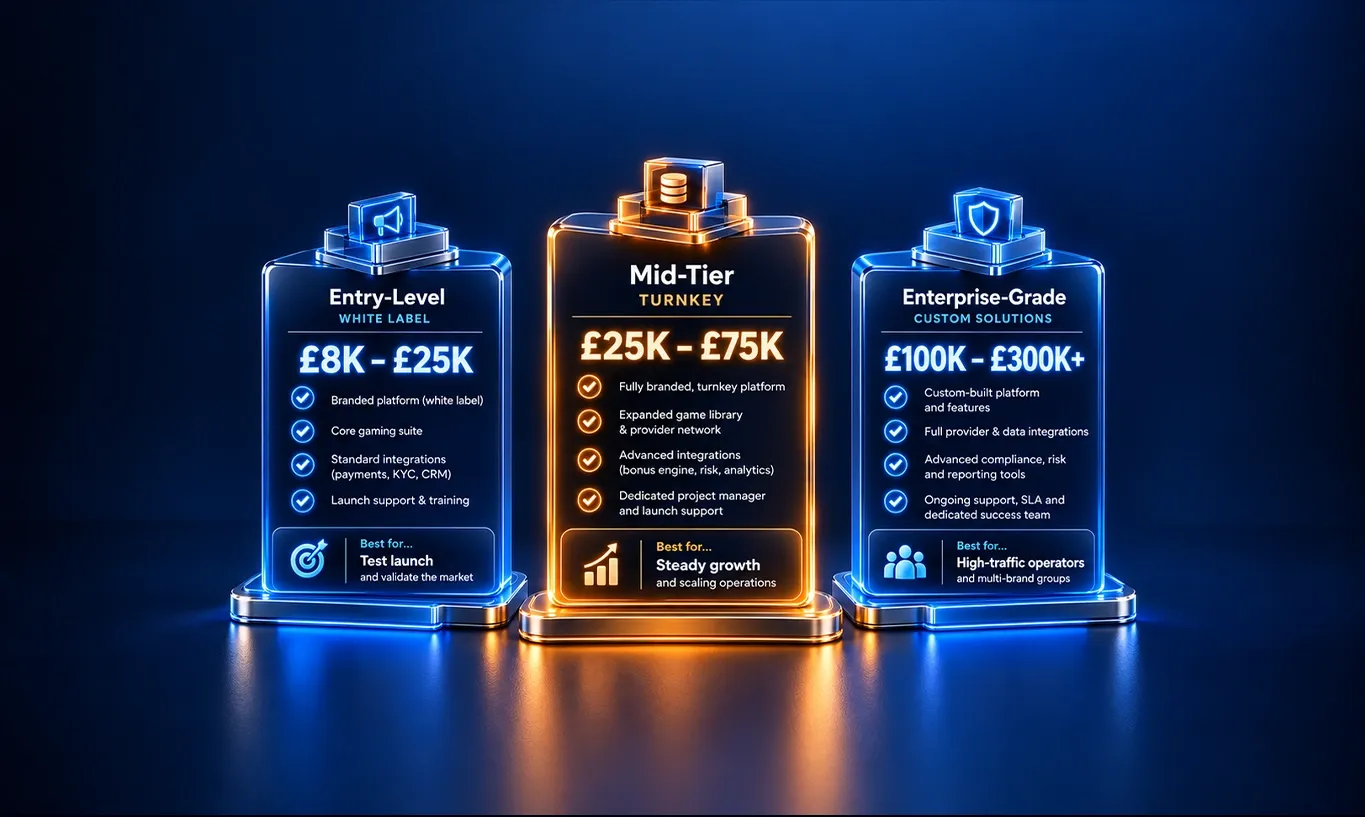
| Entry-Level White Label | Shared sportsbook platform with standard template and provider-hosted domain. Pre-match markets on major sports, basic live betting, core risk and settlement tools, ID verification, standard payment gateways, reporting dashboard, and basic support. In some jurisdictions, a white-label arrangement may operate within the licensed operator's regulatory structure. The exact model depends on local rules, and regulatory responsibility remains with the relevant licence holder. | £8,000 – £25,000 | Monthly platform fee (£2,000 – £8,000) or 15% – 30% revenue share of NGR. Some providers offer a small fixed fee + lower revenue share. |
| Mid-Tier Turnkey | Fully branded sportsbook on your own domain. Broader sports and market coverage. Enhanced in-play, CRM, and bonus tools. Multi-currency and multi-language support, sportsbook API access, licensing support for target markets, and expanded payment integrations. | £25,000 – £75,000 | Monthly platform fee (£5,000 – £20,000) or 10% – 20% revenue share of NGR. |
| Enterprise-Grade | All mid-tier features plus custom web and mobile front end. Premium/official league data (if required), dedicated trading and account management, multi-region hosting, advanced analytics and reporting, bespoke API integrations, and optional add-ons. | £100,000 – £300,000+ | Monthly platform fee (£15,000 – £50,000) or 5% – 12% revenue share of NGR. Most enterprise deals combine fixed fees with a lower revenue share. |
Entry-level suits a quick test launch. Mid-tier fits brands planning steady growth. Enterprise suits high-traffic, broader regions, and more extensive custom work.
Notes:
- These exclude gaming taxes, regulator application fees, and banking reserves.
- Premium live data, extra regions, heavy front-end design work, and non-standard payment methods can increase both setup and monthly costs.
- If you plan a broader content mix, ask for package pricing. That bundle should include a sportsbook and a casino games aggregator to improve cross-sell without stacking multiple contracts.
One-Time Setup Costs
Platform integration is the first big item. Your sportsbook must connect identity checks, payment processors, sports data feeds, risk tools, and CRM. The simpler the stack, the lower the fee. Custom flows, extra wallets, or third-party tools raise the total.
Branding and customisation come next. A simple brand asset update and colour scheme change is quick and affordable. A bespoke front-end or deep rework of the betting journey raises costs. UX research, new widgets, and localised content templates add time and testing, which increases spend.
Licensing assistance can be part of the launch package. That can include document prep, technical checks, responsible gambling features, and regulator questions. Licensing complexity varies by jurisdiction. Application requirements, technical testing, documentation, certifications and regulatory review can all affect cost and implementation timelines. Regulatory fees are market-specific and may also scale with operator size or gambling yield. For that reason, they should be budgeted separately from the underlying technology quote.
Payment gateway setup covers merchant accounts, settlement rules, and risk settings. Card and bank payments are standard. Extra payment types add work. Where crypto-assets are permitted, operators may face additional regulatory, AML, source-of-funds, customer-identification and payment-risk requirements. The exact obligations depend on the jurisdiction and implementation model.
What Other Fees Should You Expect?
Initial setup is only part of the costs. Recurring costs can become a substantial part of total cost of ownership, so operators should evaluate the full contract term rather than focusing only on the initial setup fee. Clear terms and accurate forecasts help protect your margins.
Revenue Share vs Fixed Monthly Fees
Many providers use a sportsbook revenue share model. Revenue-share agreements use a contractually defined revenue base. Check exactly which deductions, such as bonuses, taxes or other costs, are included when NGR is calculated.
Some vendors offer fixed monthly fees that cover platform access and support. Hybrid models combine a fixed platform fee with a revenue-share component, creating another option for structuring the commercial relationship. This can help with cash flow planning.
Maintenance & Technical Support Fees
Hosting, monitoring, and 24-hour coverage are included as a monthly line item. Typically, it costs £3,000–£12,000/month for mid-tier operators. Enterprise-grade SLAs with guaranteed response times under one hour push this to £15,000–£25,000/month. Separate maintenance retainers covering patches or minor feature updates may add a further £1,500–£6,000/month.
Updates to the platform, new features, and security patches are included in that bill or in a separate maintenance fee. Ask about response times, release cycles, and planned upgrades. Confirm what is included and what is custom work.
Data & Odds Feed Costs
Sports data providers charge for pre-match data, live feeds, and special markets. For a standard package covering major leagues, the fees start from around £2,000–£6,000/month. Premium leagues have higher fees. Live betting adds streaming and more frequent updates.
Your coverage choices drive this cost. More leagues and richer markets increase the total.
Payment Processing Fees
Transaction fees vary by method and region. Cards, wallets, local bank transfers, and crypto all have different rates. Chargebacks add costs and can trigger higher rolling reserves with some acquirers.
Ask for blended effective rates by market and payment method. For card-based transactions in regulated European markets, effective rates typically fall in the 1.8%–2.8% range, but local payment methods, crypto, and high-risk classifications can move that figure materially in either direction.
Licensing & Compliance Renewals
Ongoing regulatory costs can include annual licence fees, audits, testing, certifications and compliance work, depending on the jurisdiction.
Plan this into your annual budget so renewals do not catch you off guard.

Is a Turnkey Sportsbook Cheaper Than Building From Scratch?
Turnkey gives you speed and a mature stack. Custom gives you control and unique features. The right choice depends on your scale and growth plan.
Cost of Building From Scratch
To build from scratch, you need front-end and back-end engineers, mobile developers, DevOps, QA, designers, and project leads. Recruiting takes time. Retaining talent adds hidden costs. Even with a lean build, the payroll runs for many months before you take the first bet.
An odds engine and trading team is another major line. Buying every feed still leaves gaps in modelling, risk, and in-play logic. In-house trading needs analysts across sports, 24-hour cover, and strong tools. That is a serious investment.
Infrastructure covers hosting, databases, monitoring, CDNs, and disaster recovery. Sports betting traffic spikes around major matches, so capacity planning matters. Scale up and down without service dips or market delays. That is not cheap to set up or run.
Compliance and licensing take longer than many expect. Technical audits, game certifications, safer gambling tools, reporting, and change control all take time.
Time to market is a real cost in itself. While you build, others launch. You miss seasonal peaks. Live testing and iteration slow the path to net revenue.
Indicative Total: Build-From-Scratch (First 18 Months)
| Cost Line | Estimated Range |
| Development team payroll | £900,000 – £1,800,000 |
| Trading team & tools | £600,000 – £1,350,000 |
| Infrastructure & security | £130,000 – £450,000 |
| Compliance, audits & licensing | £60,000 – £180,000 |
| Recruitment & onboarding | £80,000 – £200,000 |
| Total (pre-revenue) | £1.8m – £4m+ |
The figures are illustrative, and a more precise model is available from Digitain's team directly
Cost Advantages of Turnkey Solutions
With turnkey solutions, you can launch faster and start earning sooner. A mature turnkey stack can provide established technology and integrations for areas such as payments, player management, trading, reporting and compliance workflows, reducing the amount operators need to build independently.
Lower upfront technical spend. A turnkey deal includes the platform, hosting, and core features. You pay a setup fee and an ongoing charge, not a full engineering payroll.
You still need a sharp team, yet the vendor covers the complex work. That cuts the need for senior platform hires and a full trading line-up at launch.
Operators can start with established infrastructure, tested workflows and certified sportsbook technology rather than recreating every component internally.
Digitain's Sportsbook supports 180,000+ monthly live events and 4,000+ betting markets, with 24/7 risk management and GLI-19 and GLI-33 certification — the independently verified technical standards for sports wagering systems and gaming platform integrity.
When Custom Development Makes Financial Sense
Long-term control can pay off for large brands. If you have a clear product vision, enough funds, and time, full control of the roadmap can provide gains over several years.
Unique product ideas may need custom architecture. Special bet types, unusual market rules, or new media integrations can push you past standard feature sets.
At sufficient scale, greater ownership of the technology stack may become strategically or economically attractive, but the comparison should include the full ongoing cost of development, infrastructure, trading, compliance and maintenance, not only transaction-level fees.
That is why the choice depends on your long-term plans and growth strategy.
Hidden Costs to Consider Before You Enter Into a Contract
What operators often overlook is in the fine print. Below are some hidden costs to consider before signing an agreement with a provider.
Revenue Share Minimum Guarantees
Check whether the agreement includes a minimum monthly commitment or minimum guarantee, and understand how it applies during lower-revenue periods. That floor protects the vendor. It raises your risk in slow months. Negotiate a ramp-up period or a review clause tied to traffic milestones.
Custom Feature Development Fees
Extras outside the standard roadmap will be quoted separately. New bet types, new front-end modules, special reports, or new payment links add cost. Confirm hourly rates, delivery windows, and acceptance tests. Tie payment to clear outcomes.
Marketing & Player Acquisition Costs
Affiliates, paid search, social ads, and bonuses account for a large share of spend. This is separate from platform costs yet essential to growth. Map a realistic first-quarter budget and expected CPA by market. Work back from that to set bonus rules you can afford.
Contract Lock-In & Exit Fees
Some deals set terms for a specific period. Early exit can trigger penalties or data migration fees. Clarify data ownership, migration support, and the cost to leave before the end of the term.
How to Estimate Your Total Cost of Ownership
Your first-year total is a simple sum:
Total = setup fee + 12 months of platform fees + ongoing costs + marketing spend + licence and regulatory costs for your target regions
That figure is your realistic starting budget.
Ask the provider for a line-by-line price sheet covering setup fee, monthly platform fee, revenue share or hybrid terms, data feeds by sport, payment processing by market, compliance costs, and any minimum guarantees.
Request the same view for a higher-traffic case with more sports and live features to see how costs scale.
Build two forecasts:
- One cautious plan with modest traffic and bonuses.
- One growth case with stronger acquisition and deeper live coverage.
Compare expected margin under both scenarios, then review acquisition spend, promotional strategy, trading assumptions and market coverage against your commercial targets.
Final Thoughts: Is a Turnkey Sportsbook Worth the Cost?
A turnkey path suits teams that want speed, clear costs, and a proven platform. You can launch in weeks and test real markets. You will refine the product with live players, rather than spending months on a build.
Ask for line-by-line pricing. Confirm any minimum guarantees. Check renewal terms. Request data costs by league and payment rates by country. Clarify the support scope. Get a clear exit plan with data access.
Across a full year, recurring fees often exceed the setup cost. Plan for a one-off setup fee. Add either a monthly platform charge or a revenue share. Include data feeds, hosting, payment processing, KYC, and licence renewals.
Speak with the Digitain team. We will map your markets, features, and targets, and give you a clear line-by-line quote — no surprises, no bundled extras you did not ask for.
Related Articles

Player Retention Strategies for Online Casinos and Sportsbooks
Player retention strategies for online casinos and sportsbooks. CRM triggers, loyalty design, payment speed, responsible gambling, and churn prevention.October 9, 2026Blog
What Is a Casino Games Aggregator and How Does It Work?
What is a casino games aggregator? How it connects operators to hundreds of game providers through a single API, and why most online casinos use one.October 9, 2026Blog
How RTP Configuration Affects Casino Lobby Economics
What is RTP in casino games? Learn how RTP affects slots, volatility, payouts, and casino economics for both players and operators.October 1, 2026Blog