
What Is a Casino Games Aggregator and How Does It Work?
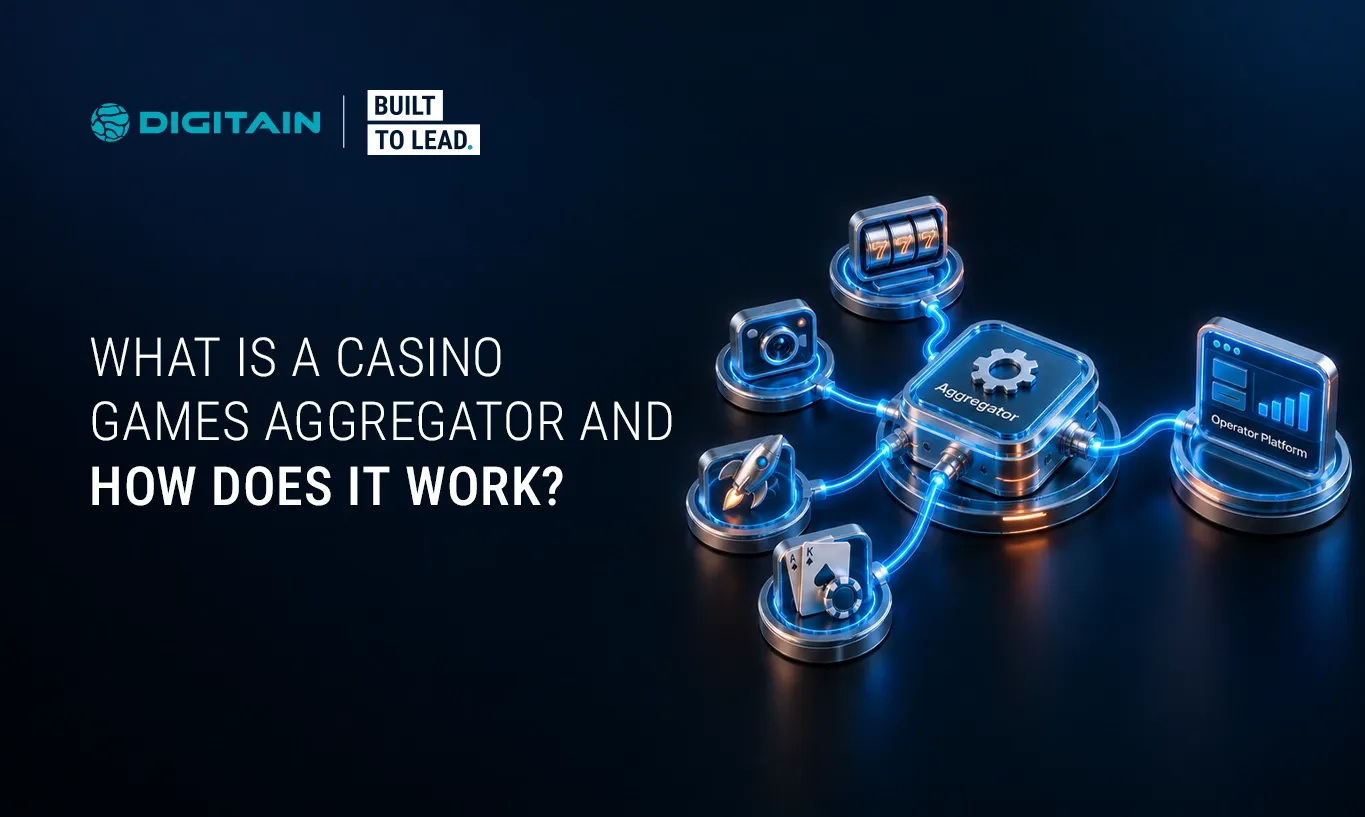
Online casinos offer thousands of titles from dozens of different game studios. Slots from one provider, live dealer from another, crash games from a third, table games from a fourth. Each studio has its own API, contract, compliance certification, reporting format, and technical support desk.
Integrating all of that directly, one studio at a time, is possible. It is also slow, expensive, and difficult to maintain. A single provider integration can take 4 to 8 weeks of engineering work. If each provider requires four to eight engineer-weeks, thirty direct integrations represent approximately 120 to 240 engineer-weeks of cumulative effort.
With three to five engineers working in parallel, that translates to an illustrative calendar range of roughly 24 to 80 weeks before allowing for contracting, certification, credentials, testing, and provider-side delays.
A casino games aggregator solves that problem. It sits between your platform and the game studios, connects to each provider on your behalf, and exposes the entire catalogue through a single API. One integration. One reporting dashboard. Hundreds of providers.
This article explains how that works in practice: the technical flow, the wallet models, what the aggregator handles versus what you control, the real cost comparison against direct integration, and where the model has limits.
How a Casino Games Aggregator Works
At a technical level, the aggregator is a middleware layer. It normalises communication between your platform and each game studio's server. Every studio builds its API differently. Data formats vary. Authentication methods vary. Session handling, bet placement, win reporting, bonus mechanics: all different from provider to provider. The aggregator absorbs that complexity and presents you with a single, consistent interface.
Here is what happens when a player clicks on a game:
- The player selects a title in the casino lobby. Your platform sends a game launch request to the aggregator's API.
- The aggregator validates the request (player session, currency, jurisdiction, game availability) and routes it to the correct game studio's server.
- The studio's server returns a game session (typically a launch URL or session payload). The player enters the game.
- Every bet, win, and balance change during the session flows through the aggregator back to your platform. The aggregator handles the translation between the studio's data format and your wallet system.
- When the session ends, the aggregator records the round data: bets placed, outcomes, payouts, session duration. That data feeds into your reporting dashboard.
Individual session, debit, and credit API calls should complete with low latency. The full customer-visible game launch may take longer because it also includes authentication, session creation, network delivery, and game-asset loading. Operators like you should request median, p95, and p99 latency data for each critical endpoint rather than rely on one headline number. The player sees none of this complexity. They click a game, it loads, they play. Behind that click, the aggregator manages the handshake between systems that use different authentication, wallet, session, and reporting standards.

Wallet Models: Seamless vs Transfer
One of the first technical decisions you make when connecting to an aggregator is which wallet model to use. There are two.
Seamless (common) wallet. In a seamless-wallet model, your wallet remains the authoritative balance ledger. When a player places a bet, the aggregator sends a debit request to your wallet. When they win, the aggregator sends a credit request. Money never leaves your system. It gets debited and credited in real time as the player plays. The integration must still support idempotency, rollback, retry, interrupted-round, and reconciliation procedures to resolve failed or delayed transactions.
This is the model most operators prefer. It gives full control over player balances and simplifies reconciliation. The downside: your wallet API needs to handle high-frequency requests with low latency. If the wallet is slow, the game feels slow.
Transfer wallet. Player funds are moved to a temporary session wallet when the player launches a game. The aggregator manages that wallet for the duration of the session. When the player exits, the remaining balance transfers back to your main wallet.
This model reduces the real-time API load on your system but adds complexity to reconciliation. It is less common in 2026 because most modern platforms can handle seamless wallet speeds without difficulty.
Digitain's casino API supports seamless wallet integration, which means operators maintain full control of player balances while the aggregator handles session management and game communication.
What the Aggregator Handles (and What You Control)
The split is cleaner than most people expect.
The aggregator maintains distribution relationships with connected studios and centralises much of the commercial onboarding. Depending on the supplier, jurisdiction, and operator model, additional approvals, schedules, or direct agreements may still be required. It signs distribution agreements with each game studio, though you may need provider-specific approvals or commercial documents depending on the jurisdiction and supplier.
When a studio updates its API, changes its data format, or releases a new game, the aggregator absorbs the change. Your integration does not break. The new game appears in the back office, ready to activate without development work.
A mature aggregator can centralise certification documents and market-availability rules, but catalogue access does not automatically establish approval in every jurisdiction. Before activation, you should verify the exact game and software version, theoretical RTP configuration, issuing test laboratory, certificate scope and validity, supplier licence or registration status, jurisdictional acceptance, and required operator game-register or notification entries.
Round tracking, reporting, and promotional tools also sit on the aggregator side. Every bet, outcome, and payout is recorded and surfaced through your dashboard. Free spin campaigns and jackpot pools can be configured in the back office without contacting individual studios.
What stays with you is the player relationship. Registration, KYC, deposits, withdrawals, account management: all operator-side. You also control lobby curation (which games are visible, how they are organised, what gets featured), bonus strategy (the commercial terms, wagering requirements, and promotional logic), and market-specific configuration (which games are available in which jurisdictions, which currencies, which responsible gambling tools are active).
Think of it this way. The aggregator is the supply chain. You are the shop floor. The aggregator makes sure the products arrive with documentation. You decide what goes in the window, what price to mark it at, and how to treat the customers.
The Cost of Going Without One
The commercial case for an aggregator becomes clear when you compare the two routes side by side.
Direct Integration (No Aggregator)
Say you want to launch with 20 providers. Each one needs its own commercial negotiation. Its own contract. Its own API integration, which typically takes 4 to 8 weeks of engineering per provider. Each one needs separate compliance certification for every jurisdiction you operate in. Separate testing, QA, and user acceptance testing. Separate reporting feeds that your BI team needs to normalise into a single view. And every time that provider updates its API or releases a batch of new titles, your engineering team needs to handle the change.
Twenty integrations at four to eight engineer-weeks each represent approximately 80 to 160 engineer-weeks of cumulative effort. With three to five engineers working in parallel, the theoretical elapsed development time is approximately 16 to 53 weeks. Commercial contracting, supplier access, compliance evidence, and UAT may extend that schedule. In practical terms, it means hiring 3 to 5 additional engineers just to manage provider integrations. That runs £150,000 to £300,000 per year in salary alone.
Aggregator Route
You integrate once with the aggregator's API. That takes 2 to 4 weeks depending on complexity. After that, adding a new provider is an activation in the back office, not a development project.
In many cases, existing certifications and integrations can significantly reduce the additional compliance and technical work required, although jurisdiction-specific testing, certification, approval, or notification requirements may still apply.
Direct integration and aggregation both involve content costs. The difference is in the cost structure.
Direct integration typically includes the studio's commercial fee or revenue share, internal integration and QA costs, legal and contracting work, certification and market-approval work, and ongoing API maintenance and reporting normalisation.
Aggregation typically includes underlying game-supplier commercial costs (either embedded or passed through), an aggregation or platform fee, and substantially lower internal integration and maintenance overhead.
The relevant comparison is total cost of ownership, not "revenue share versus no revenue share."
Direct annual cost = studio/content fees + engineering + QA + compliance + legal + maintenance
Aggregator annual cost = underlying content fees + aggregator fee + reduced internal operating cost
Operators should model both routes using projected GGR by provider and the exact definitions in each commercial agreement.

When Direct Integration Still Makes Sense
There are edge cases where integrating directly with a studio is the right call.
If one provider generates a material share of your casino GGR, a direct commercial and technical relationship may become worth modelling. The decision should compare the provider-specific aggregator margin with the cost of direct integration, maintenance, certification, and reporting.
Some operators integrate their top 3 to 5 providers directly for commercial and strategic reasons, and use the aggregator for everything else. This hybrid approach gives them better terms on their highest-volume content while using the aggregator's efficiency for the long tail.
But these are exceptions. For operators launching with a curated multi-provider portfolio, aggregation is often the practical route because it centralises technical integration, wallet communication, reporting, and supplier updates while reducing duplicated maintenance work.
What To Look for When Evaluating an Aggregator
Not all aggregators are built the same, and the differences matter more than most operators realise during the evaluation stage.
Start with the catalogue. Raw title count is a vanity metric. What matters is whether the aggregator carries the studios your target market actually plays. An aggregator that includes Evolution, Pragmatic Play, Play'n GO, NetEnt, and Hacksaw Gaming covers most operators' needs. One that is missing two of those names has a gap players will notice within the first session. Check the provider list against your target markets before anything else.
Jurisdictional coverage is the next filter. Game availability varies by market. A title certified for Malta may not be available in the UK. Another might work in Latin America but not in Scandinavia. The aggregator should handle per-market game filtering automatically based on your licence configuration. If you have to manage that filtering manually, you are doing the aggregator's job for it.
After those two filters, the evaluation becomes more operational. Can you run free spin campaigns and configure jackpot pools through the back office, or do you need to contact each studio? How fast do new releases appear after a provider launches them? Hours are good. Weeks is a problem. Does the reporting dashboard show per-game, per-provider, and per-market performance in a single view, or do you need to stitch data together yourself?
The wallet integration model matters too. Seamless wallet support is the standard now. If the aggregator only supports transfer wallet, ask why. And check the latency under load. Operators should request median, p95, and p99 latency benchmarks for each critical endpoint. A wallet API that slows down during peak traffic creates a player experience problem that no amount of game content can fix.
One last thing that separates the good aggregators from the adequate ones: whether the aggregator is a standalone content pipe or part of a broader platform that includes CRM, player segmentation, and responsible gambling tools. A standalone pipe does one job well. A platform gives you control over the full player experience without bolting on three more systems and hoping they talk to each other.
How Aggregation Connects to Licensing
Most aggregator guides skip this point, and it is the one that catches operators off guard.
The use of an aggregator does not remove the operator’s responsibility to ensure that games offered to players comply with the requirements of the relevant jurisdiction. Aggregators, game suppliers and other B2B providers may also have separate licensing, certification and compliance obligations depending on the applicable regulatory framework.
That said, an aggregator with established testing and market documentation can reduce the practical compliance workload. You must still verify the exact game versions, suppliers, configurations, and approvals used in its own licensed deployment.
Where it gets specific: the Curaçao LOK requires operators to disclose all third-party game suppliers on the CGA portal. The UKGC requires all game software to comply with the Remote Technical Standards, and the June 2026 RTS update introduced new requirements.
Under the MGA framework, relevant game types must meet the applicable minimum RTP requirement, and game rules must be readily available to the player. Separately, the B2C operator must provide the responsible-gambling information, limits, self-exclusion, and customer-protection processes required by the Player Protection Directive. Under Gibraltar's new Gambling Act 2025, all content providers must be approved by the Licensing Authority.
In Gibraltar specifically, a content studio supplying through an aggregation platform may require a separate content-provider approval. The current prescribed fee is £1,000 per approval. Operators should identify the providers actually planned for the Gibraltar catalogue, confirm whether each holds a full Gibraltar B2B licence or requires content-provider approval, and agree contractually which party manages and pays for the application.
An aggregator with established testing and market documentation can reduce the practical compliance workload. You must still verify, document, and maintain oversight. The aggregator handles the logistics. The responsibility stays with the licence holder. And any aggregator that implies otherwise is one you should walk away from.
[INTERNAL LINK]
"Curaçao LOK" links to How to Get a Curacao iGaming Licence
“UKGC” links to How to Get a UK Gambling Commission (UKGC) Licence in 2026
“MGA” links to How to Get a Malta Gaming Authority (MGA) Licence in 2026
“Gibraltar's new Gambling Act 2025” links to How to Get a Gibraltar iGaming Licence
Digitain's Casino Games Aggregator
Digitain's casino games aggregator connects you to 55,000+ titles from 360+ providers through a single API. The catalogue covers every major game vertical: slots, live casino, RNG table games, crash games, bingo, keno, jackpots, and skill games.
What sets it apart from a standalone content pipe is what sits around it. The aggregator is part of a broader platform that includes CRM, bonus management, player account management, and a content management system built for iGaming. You manage your game library, player segments, promotional campaigns, and responsible gambling tools from one back office. Free spin campaigns, jackpot pools, and bonus distribution run through the same interface without contacting individual studios.
The casino API integration supports seamless wallet integration. The integration uses documented security controls, encryption, fraud monitoring, and access-management procedures. You should confirm the applicable ISO/IEC 27001 certificate and scope during technical due diligence.
The integration launches in 2 to 3 weeks. New game releases from connected providers can be made technically available through the back office. You should still review certification, market eligibility, and promotional suitability before publishing new titles to the lobby.
For operators who want the full stack, the turnkey solution brings sportsbook, casino aggregation, virtual sports, payments (Paydrom, 600+ methods, 150+ currencies), affiliate management, and CRM together in one platform.
For operators who already have a platform and want to add casino content, the API integration plugs in without replacing what you have built.
Digitain holds licences and certifications across Malta (MGA), the UK (UKGC), Romania, Greece, Belgium, Peru, Brazil, and Curaçao. You can see the full list on our licences and certifications page. If you are evaluating aggregators and want to see how ours works in practice, talk to our team.
This article is for informational purposes only. Regulatory requirements, certification standards, and technical specifications are subject to change. Always consult qualified legal and technical counsel before making integration decisions.
Related Articles

Player Retention Strategies for Online Casinos and Sportsbooks
Player retention strategies for online casinos and sportsbooks. CRM triggers, loyalty design, payment speed, responsible gambling, and churn prevention.October 9, 2026Blog
How RTP Configuration Affects Casino Lobby Economics
What is RTP in casino games? Learn how RTP affects slots, volatility, payouts, and casino economics for both players and operators.October 1, 2026Blog
Types of Casino Games: A Complete Guide for Players and Operators
What types of casino games are there? From slots and table games to crash games and live dealer, here is every category explained for players and operators.October 1, 2026Blog