
How RTP Configuration Affects Casino Lobby Economics
Two versions of the same slot can produce materially different theoretical margins. For operators, the relevant questions are which certified RTP configuration is deployed, how accurately it is disclosed, how actual performance is monitored and how the game affects bonuses, GGR and portfolio balance.
This guide explains how to evaluate theoretical RTP, actual RTP, volatility, jackpot contribution and configuration differences across a casino catalogue.
Why Every Spin Depends on RTP in Gambling
Most casino games can be described using a theoretical RTP or equivalent likelihood measure. Fixed-maths slots usually have a defined RTP for each certified configuration, while blackjack depends on rules and strategy, and progressive products may separate base-game and jackpot return components
That long-run part matters most. RTP does not describe what happens in your next 20 spins. It does not mean a game “owes” money after a cold run. It shows the statistical average across a huge sample size.
What 96% RTP Looks Like
Suppose a slot generates £100,000 in total turnover at 96% theoretical RTP. Across a sufficiently large sample, the model expects approximately £4,000 to remain as the game's theoretical gross gaming revenue before operational adjustments.
That does not mean every customer loses 4% of their deposit. Individual outcomes can differ dramatically, and turnover may include winnings that are wagered again.
RTP must be explained carefully because it is an average achieved over a significant volume of play, not a promise about one customer’s session.
RTP vs. House Edge
House edge is the flip side of RTP:
House Edge = 100% - RTP
Compared with European roulette at approximately 97.3% RTP, a 96% RTP slot has a higher theoretical cost: £40 rather than £27 in expected player loss per £1,000 of turnover.
What Does RTP Mean in Slots?
Slots are where most people first notice RTP. Each slot title has its own figure, so the gap from one game to the next can be big. Many online slots offer near 96%. Some low-paying land-based or jackpot-heavy titles can fall into the mid-80s. Some online slot configurations publish theoretical RTP figures above 98%, but these versions are not necessarily available through every operator, jurisdiction or supplier agreement.
In slots, RTP is part of the game’s maths model. It shapes long-run return, house edge, and the expected cost of play.
Why Slot RTP Behaves Differently From Table Game RTP
Table games often tie RTP to player choices. Blackjack can reach about 99.5% with an optimal strategy. Weak decisions cut that number down. Slot RTP works in a different way. The outcome of each spin comes from a Random Number Generator, or RNG. In a conventional RNG base game, previous losing outcomes do not make a win due on the next spin. Some games also include persistent meters, collected symbols or jackpot states, whose current status must be explained separately in the game rules.
For most modern slots, player skill does not change the theoretical RTP of the selected certified version. A smaller group of games includes decision-based features, stake conditions or published strategies that can affect the effective return. Supermeter-style titles should therefore be reviewed separately rather than grouped with conventional fixed-RTP slots.
This matters to operators too. A bonus tied to slots behaves very differently from a bonus tied to blackjack or roulette. Slot returns are fixed in the game maths. Table game returns can shift with player decisions and rule sets.
Where to Find a Slot’s RTP Before You Play
Operators should reconcile the RTP displayed in the lobby, game-information panel, provider metadata and certification record. If the values differ, the game should be reviewed before further promotion or deployment to confirm the active version and correct every player-facing disclosure.
Request a casino-catalogue review to assess game versions, theoretical RTP configurations, volatility, jackpot contribution, certification and market availability across your target jurisdictions.
How Is RTP Calculated?
The formula is direct:
Actual RTP (%) = Total prizes paid ÷ Total turnover × 100
Theoretical RTP is the designed long-run return established by the certified game model.
Actual RTP is measured over a defined operational period and may differ from theoretical RTP within the game’s expected volatility tolerance.
Theoretical RTP is established through mathematical analysis and simulation at a scale appropriate to the game model. Once the game is live, actual RTP is monitored against volatility-based tolerance limits rather than by waiting for one universal number of spins.
Approved testing laboratories assess the game’s mathematical model, RNG and software against specified technical standards. The resulting report or certificate can support regulatory approval, but acceptance depends on the jurisdiction, laboratory recognition, game version and operator deployment.
UKGC testing documentation is version-specific and includes game name, RTP, software number, digital signature, platform and test scope.
Theoretical RTP vs. Actual RTP
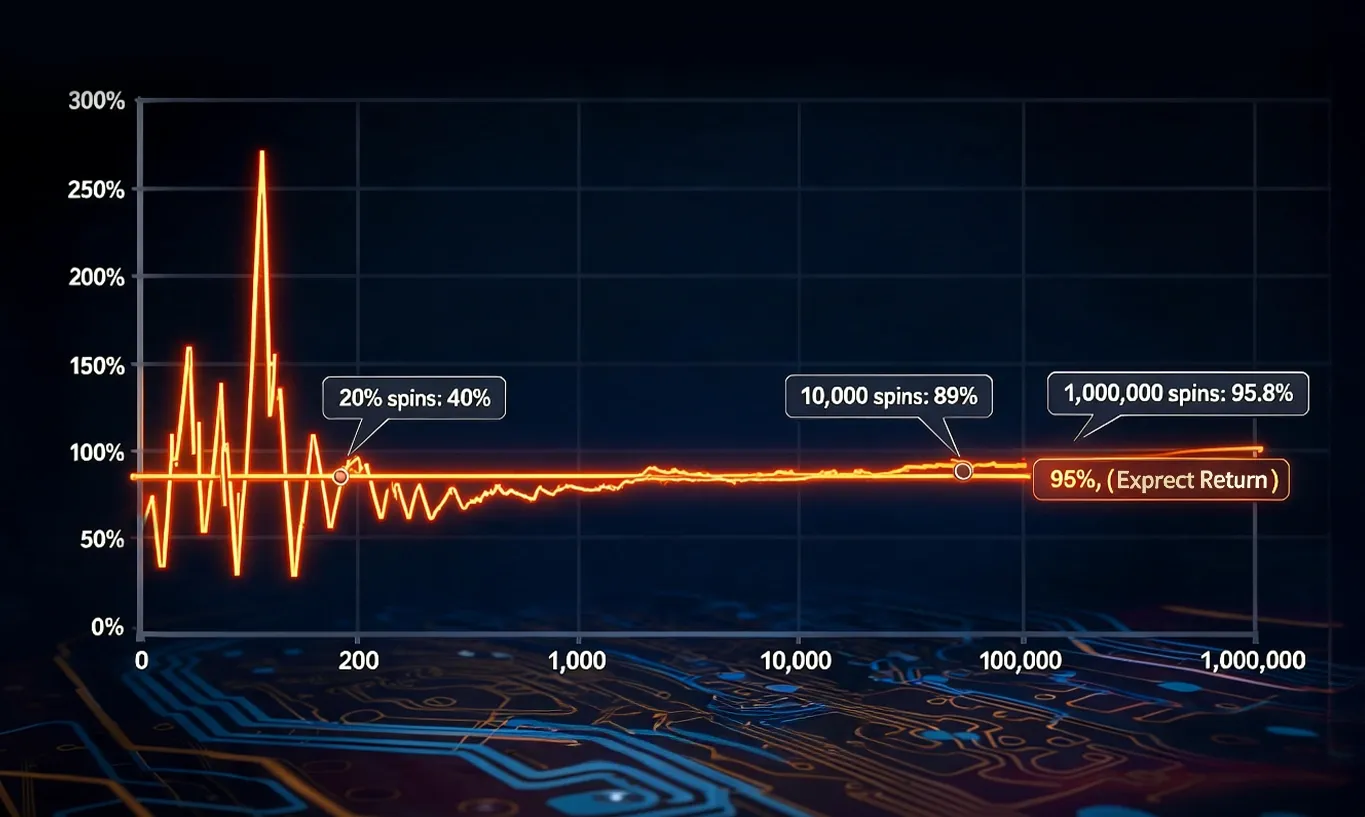
Theoretical RTP is the long-run return predicted by the game model. Actual RTP is the amount the game has paid out so far in real play.
These two numbers can be far apart in the short term. In a 200-spin session, your personal return could be 40%, 0%, or 300%. None of those outcomes proves the published RTP is wrong. They just show how different short sessions can be.
Over a very large sample, actual RTP tends to move closer to theoretical RTP. That is the law of large numbers in action. The bigger the sample, the smaller the gap becomes. This is why a player’s session result and the published RTP can look nothing alike.
RTP vs. Volatility in Slots
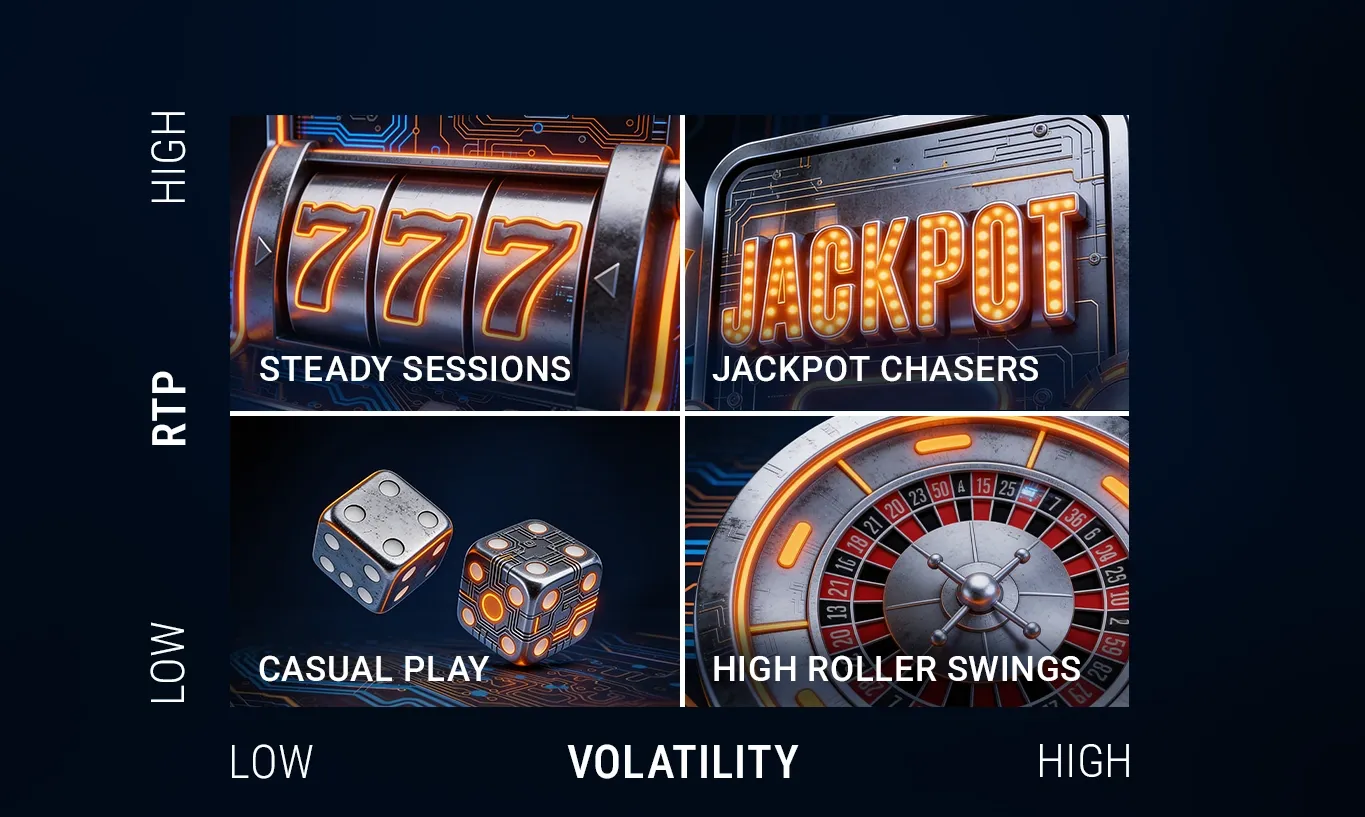
RTP tells you how much a game returns over time. Volatility tells you how that return is spread out. One number speaks to the long-run average. The other speaks to the shape of the ride.
A slot can have strong RTP and still feel brutal if it pays in rare, heavy bursts. Another slot can have the same RTP and offer lots of small hits.
Same RTP, Wildly Different Experiences
Take two slots at 96% RTP. A low-volatility title might pay small wins often and keep your balance positive for longer. Starburst is the classic example many players use for that style. A high-volatility title at the same RTP may stay quiet for long stretches, then drop a much larger hit. Dead or Alive 2 often sits in that camp.
That is why RTP alone does not tell the whole story. You need the return number and the win pattern together.
Applying RTP and Volatility to Casino Portfolio Decisions
Suggested operator matrix:
Low volatility: frequent smaller returns; review session behaviour, bonus cost and feature pacing.
High volatility: less frequent larger returns; review payout concentration, customer communication and markers of harm.
Progressive jackpot: separate base and jackpot RTP; verify eligibility, contribution and disclosure.
Multiple RTP versions: document the deployed configuration, certification and market approval.
Here is a simple way to match the two:
| Player type | Better fit | Reason |
| Casual player with a small bankroll | Low volatility and high RTP | More playtime and smaller swings |
| Jackpot chaser | High volatility with an RTP you can accept | Bigger upside, longer dry spells |
| Bonus wagering focus | Low volatility with the highest RTP available | Lower bankroll swings during playthrough |
Operators can use the same logic when arranging a lobby. Low-volatility titles help keep sessions steady. High-volatility slots produce less frequent but potentially larger payouts. Operators should present this characteristic clearly, balance different volatility profiles across the lobby and monitor whether product use is associated with indicators of gambling-related harm.
CRM and player-management data can help operators analyse product preferences, engagement and risk indicators. Personalisation rules should exclude customers showing relevant markers of harm and should operate within the operator’s responsible-gambling and product-governance framework.
Highest RTP Slots Worth Knowing About
High RTP slots can cut expected losses over time, yet they do not always make the best pick for every player. Many of the highest-return titles work on older maths models and lower volatility. That can suit longer sessions. It may feel flat to players who want big swings.
The figures below reflect commonly cited default RTP settings from provider sheets. Operators may list lower pre-set versions of the same game.
Top 10 High-RTP Slot Titles
| Slot title | Provider | RTP | Volatility |
| Mega Joker | NetEnt | 99.0% | Low |
| Jackpot 6000 | NetEnt | 98.8% | Medium |
| 1429 Uncharted Seas | Thunderkick | 98.6% | Low |
| Marching Legions | Relax Gaming | 98.1% | Medium |
| Blood Suckers | NetEnt | 98.0% | Low |
| Starmania | NextGen | 97.9% | Low-Medium |
| Kings of Chicago | NetEnt | 97.8% | Medium |
| White Rabbit Megaways | Big Time Gaming | 97.7% | High |
| Devil’s Delight | NetEnt | 97.6% | Medium |
| Big Bad Wolf | Quickspin | 97.3% | Medium |
The Jackpot Contribution
Progressive jackpot slots can fool the eye if you only look at the headline prize. Part of each wager often goes into the jackpot pool. That lowers the base game return.
So what is the trade-off? You accept a lower regular return for a tiny chance at a life-changing hit.
For operators, these games can support player acquisition and spark interest. They work best next to higher-RTP filler titles that support longer play and steadier retention.
Digitain’s casino aggregation technology provides centralised access to a broad portfolio of third-party games through one API. Operators should confirm the current catalogue size, provider count and availability of version-level RTP metadata with the Product team.
5 RTP Myths That Cost Players and Operators Money
Myth 1: A slot is due after a long losing streak.
Fact: Each spin is independent. The RNG does not track past results. In a conventional RNG slot, a previous losing result does not make a winning result due on the next spin. Each new game cycle is resolved according to the certified game logic.
Myth 2: Higher RTP means I will win more often.
Fact: RTP measures total return, not hit frequency. A 98% slot with high volatility can pay less often than a 94% slot with low volatility.
Myth 3: Online slots pay less than land-based machines.
Fact: Land-based and online RTP figures should be compared using specific jurisdictions, game categories and certified versions. Channel alone does not establish that one product has a higher or lower RTP.
Myth 4: Casinos can secretly change RTP any time they want.
Fact: In regulated markets, a live game setting must match the certified version filed with the regulator. Some studios give operators a choice of pre-set RTP tiers at setup.
Myth 5: RTP tells me what I will get back tonight.
Fact: RTP is a long-run average across millions of rounds. Your own session can land far above or far below it.
Why RTP Matters for Players and for Operators
RTP matters at both ends of the casino stack. Players use it to compare games. Operators use it to shape the game mix, bonus costs, and expected GGR.
Smarter Game Selection for Players
If two slots look equally fun, RTP gives you a rational tie-breaker. A jump from 94% to 97% may sound small, but it reduces the theoretical expected player loss from 6% of turnover to 3%. If you have to clear £10,000 in wagering, that 3% gap equals £300 in expected outcome.
Still, RTP should be added next to volatility, theme, bankroll, and bonus rules. A high-RTP slot with brutal swings can drain a small balance fast. A lower-volatility title with a slightly lower RTP may fit your session better.
Game Curation, Trust and Licence Rules for Operators
For operators, RTP feeds straight into GGR planning. If players wager £1,000,000 on a 96% RTP game, the long-run retained amount is about £40,000. That does not predict each day’s result, yet it gives a clean benchmark for the game mix.
Clear RTP display helps trust too, and certified values must match what the player sees. A balanced lobby may include games with different theoretical RTP, volatility and jackpot structures. Operators should evaluate each category through actual engagement, GGR, supplier cost, bonus exposure, complaints and responsible-gambling indicators rather than assuming that one RTP band guarantees retention.
Final Words
RTP is one of the clearest numbers in gambling once you strip away the myths. It shows long-run return, not a promise for one session. If you play, use it with volatility, bankroll limits, and time limits.
If you run an iGaming brand, clear RTP data helps trust, game selection, and licence discipline. Digitain supports 150+ operators with sportsbook, casino, CRM, payments, and tools that put certified game data front and centre.
Digitain’s Centrivo platform gives operators clear tools for game curation, player group management, and compliance with regulatory requirements across markets. Request a demo here.
Share This Article
Related Articles

Types of Casino Games: A Complete Guide for Players and Operators
What types of casino games are there? From slots and table games to crash games and live dealer, here is every category explained for players and operators.October 1, 2026Blog
How Long Does It Take to Launch a Turnkey Sportsbook?
Learn how long it takes to launch a turnkey sportsbook, from setup and licensing to payments, testing, and go-live, plus common delays.September 25, 2026Blog
iGaming Platform Migration: Switch Without Losing Momentum
Learn how to migrate your iGaming platform while protecting player data, reducing disruption, maintaining revenue, and creating a foundation for growth.September 25, 2026Blog