
How to Get a UK Gambling Commission (UKGC) Licence in 2026
The UKGC licence is the hardest to get, the most expensive to maintain, and the one that opens the most valuable single market in iGaming.
The UK generated £12.6 billion in gross gambling yield (GGY) excluding lotteries in the year to March 2025. Remote casino GGY alone hit £5 billion, up 72% since 2017/18. Around 46% of British adults participate in some form of gambling. For operators with the scale and compliance infrastructure to compete here, the UK is the market that defines whether you are a serious business or a regional one.
But 2026 changed the maths significantly. On 1 April 2026, Remote Gaming Duty rose from 21% to 40% on casino GGY from UK players. Remote betting duty increased to 25%. A separate fee consultation published in March 2026 proposes a 30% increase in UKGC licence fees. These are not small adjustments. They reshape the unit economics of UK market entry for every operator evaluating the jurisdiction.
This guide covers the UKGC licensing framework as it stands after those changes: who needs a licence, what it costs (including the new duty rates), the application process, Personal Management Licence requirements, ongoing obligations, and a realistic assessment of who the UK market is actually for.
Who Needs a UKGC Licence
The UK operates on a point-of-consumption model. If you provide gambling services to players located in Great Britain, you need a UKGC licence. It does not matter where your company is incorporated, where your servers sit, or where your staff works. If British players can access your product, you need a licence.
Operating without one while accepting UK players is a criminal offence under the Gambling Act 2005. The UKGC actively monitors unlicensed operators, issues blocking orders to payment providers and ISPs, and refers serious cases for criminal prosecution.
There is no requirement to be incorporated in the UK. Any entity from any jurisdiction can apply. But you must maintain a UK correspondence address (not a PO Box) for the life of the licence. The address must be a location where you have a consistent staff presence, or the address of an official representative, such as a solicitor or accountant.
Licence Types for Remote Operators
The UKGC issues separate operating licences for each gambling activity. A B2C operator typically needs one or more of the following:
| Licence | What It Covers |
| Remote Casino | Casino games, slots, poker, roulette, blackjack, and other RNG games |
| Remote General Betting (Real Events) | Sports betting on real events |
| Remote General Betting (Virtual Events) | Betting on virtual/simulated events |
| Remote Bingo | Online bingo |
| Remote Pool Betting | Pool betting and betting exchanges |
If you operate a casino and a sportsbook, you need two operating licences. Each carries its own application fee and annual fee, calculated separately based on GGY per licence activity.
B2B suppliers (platform providers, game studios, software companies) that provide gambling software to UK-licensed operators need a Remote Gambling Software Licence. There is also a Casino (Game Host) licence for software businesses that host games on their own servers but only serve them through other operators' platforms.
Fees
UKGC fees are structured in bands based on Gross Gambling Yield (GGY) — the amount players lose to the operator (stakes minus winnings returned). Higher GGY means higher fees. Fees apply per licence activity.
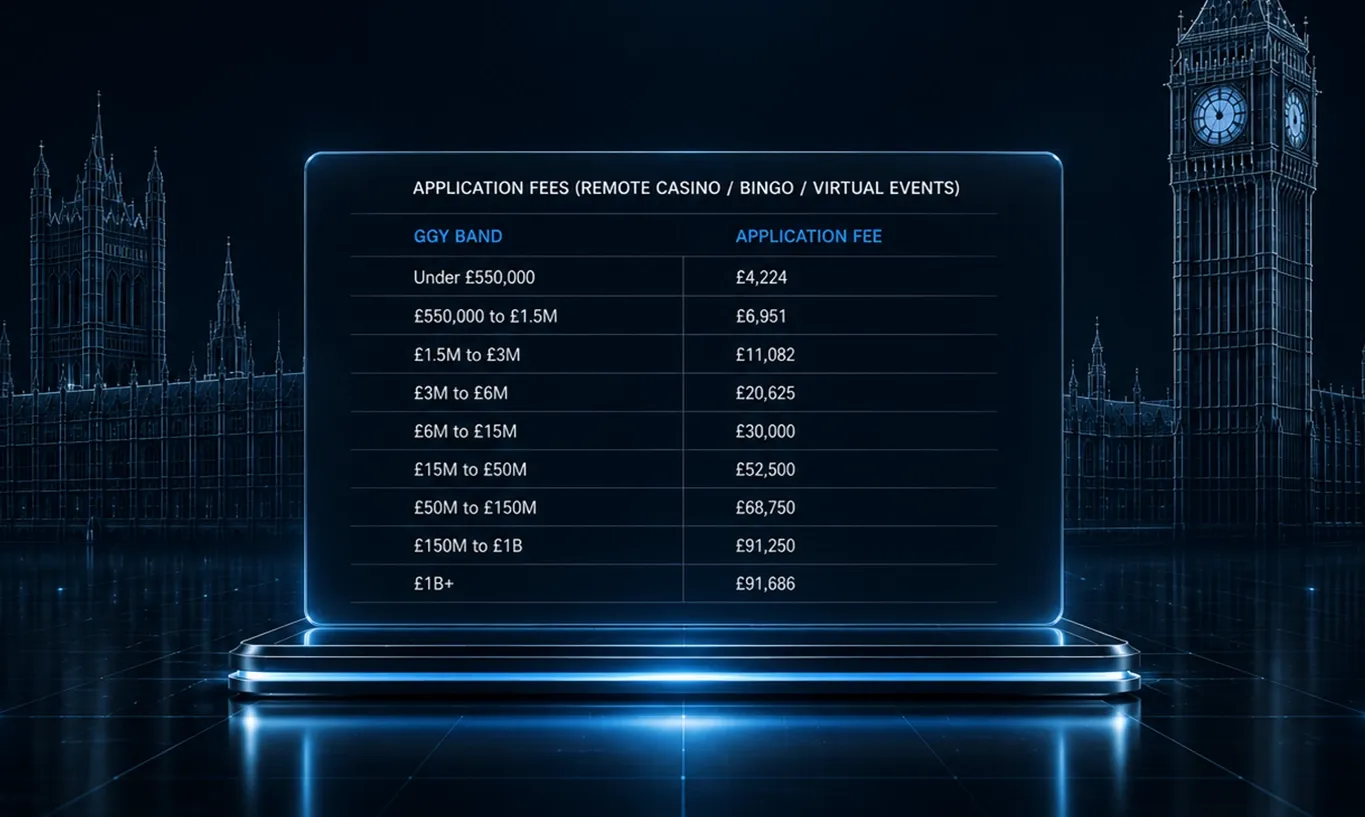
Application Fees (Remote Casino / Bingo / Virtual Events)
| GGY Band | Application Fee |
| Under £550,000 | £4,224 |
| £550,000 to £1.5M | £6,951 |
| £1.5M to £3M | £11,082 |
| £3M to £6M | £20,625 |
| £6M to £15M | £30,000 |
| £15M to £50M | £52,500 |
| £50M to £150M | £68,750 |
| £150M to £1B | £91,250 |
| £1B+ | £91,686 |
Application fees are non-refundable, even if the application is unsuccessful or withdrawn.
Annual Fees
Annual fees follow the same GGY bands, ranging from approximately £4,199 for the smallest operators to £793,729 plus £125,000 per additional £500M of GGY for the largest. Your first annual fee is due 30 days after the licence is issued and is reduced by 25%. After that, fees are due annually on the licence anniversary.
Remote general betting (real events) uses a 10-bracket system with different thresholds and amounts. Use the UKGC's online fee calculator for exact figures before budgeting.
Personal Management Licences
Each PML costs £1,234 per person. A mid-size operator typically needs 3 to 6 PMLs (CEO, CFO, compliance head, MLRO, head of operations, marketing director). That adds £3,702 to £7,404 in PML application costs.
Fee Consultation: Proposed 30% Increase
In March 2026, the UKGC published a fee consultation proposing a 30% headline fee increase. The proposal would significantly raise fees for remote casino licensees, which the UKGC says have "fallen behind" its regulatory effort and strategic focus. Remote casino generates one-third of the industry market share but currently contributes a disproportionately low share of fee revenue.
If adopted, the new fees would take effect in late 2026 or early 2027. Operators planning a UK entry should budget for the higher rates.
The Tax That Changes Everything: Remote Gaming Duty at 40%
This is the single most important number for any operator evaluating the UK in 2026.
On 26 November 2025, HM Treasury announced sweeping changes to gambling taxation, effective 1 April 2026:
| Tax | Old Rate | New Rate (from 1 April 2026) |
| Remote Gaming Duty (casino, slots, poker) | 21% of GGY | 40% of GGY |
| General Betting Duty (remote sports betting) | 15% of net profits | 25% |
| Bingo Duty | 10% | Removed entirely |
Remote Gaming Duty (RGD) is paid to HMRC, not to the UKGC. It applies on a point-of-consumption basis: if the player is in the UK, the duty applies regardless of where the operator is located.
What this means in practice. An operator generating £10 million in UK casino GGY pays £4 million in Remote Gaming Duty. Under the old rate, that was £2.1 million. The increase is £1.9 million per year on the same revenue. For a mid-size operator, that is the difference between a profitable UK operation and a marginal one.
On top of RGD, operators pay a statutory levy introduced in April 2025: 1.1% of GGY for online operators (0.5% for land-based). This funds research, prevention, and treatment of problem gambling.
Combined tax burden for a UK remote casino operator in 2026: 40% RGD + 1.1% statutory levy = 41.1% of GGY paid to the government before UKGC licence fees, operational costs, marketing, and staff.
No other major jurisdiction comes close to this tax rate. Malta charges 5% (on Malta-sourced revenue only). Gibraltar charges 0.15% (first £100K exempt). Curaçao charges nothing. The UK is in a category of its own.
This does not mean the UK is not worth it. The market is enormous, and the credibility of a UKGC licence opens doors that no other licence can. But the maths only works at scale. Operators with thin margins or low UK GGY projections will find the unit economics difficult.
The Application Process
All applications are submitted through the UKGC eServices portal. The Commission assigns a case officer who manages the review.
What You Need Before You Apply
The UKGC expects a complete, submission-ready application. Incomplete packages trigger information requests that add 4 to 8 weeks per round. First-time applicants average 1 to 2 RFI rounds.
Your application package should include:
- Business plan covering product scope, target market, operating model, responsible gambling strategy, and projected GGY (needed for fee band calculation)
- Financial projections and source of funds evidence (minimum 12-month projections demonstrating financial sustainability)
- Corporate structure showing all shareholders, UBOs, and directors
- AML/CFT policies written specifically for your business model (not a generic template)
- Safer gambling policy including self-exclusion tools, deposit limits, reality checks, and procedures for identifying vulnerable players
- GAMSTOP integration plan (self-exclusion scheme; all UK-licensed remote operators must participate)
- Technical documentation covering platform architecture, RNG certification, and compliance with the UKGC's Remote Technical Standards (RTS)
- PML applications for all individuals in key management roles
The Review Process
Once submitted, the UKGC conducts:
Suitability assessment. Background checks on all key persons, shareholders, and UBOs. Criminal record checks, regulatory history, financial integrity. The UKGC has information-sharing agreements with regulators worldwide.
Financial review. Are you adequately capitalised? Is the source of funds clean and traceable? Can you sustain operations and pay players?
Technical assurance. Does your platform meet RTS standards? Is the RNG certified? Are security measures adequate?
AML/CFT review. Are your policies genuine and operational, or did you copy a template? The UKGC specifically looks for policies written to your business model, not generic frameworks.
Safer gambling review. Do you have real tools for player protection? GAMSTOP integration? Deposit limits? Self-exclusion functionality? Procedures for identifying and interacting with potentially vulnerable players?
Timeline
The UKGC publishes a target of 16 weeks for processing operating licence applications. In practice, the timeline depends heavily on how prepared the applicant is.
- Well-prepared application: 4 to 8 months from submission to licence
- Including pre-application preparation: 11 to 18 months end-to-end
- Complex structures or RFI cycles: 12+ months from submission
The pre-application period (building compliance infrastructure, recruiting PML holders, preparing documentation) often takes longer than the review itself. Plan for it.
Personal Management Licences (PMLs)
A PML is required for every individual performing key management functions within a licensed gambling operation. According to the UKGC's PML guidance, this includes anyone responsible for:
- Overall management and direction of the business
- Overall strategy and delivery of gambling operations
- Financial planning and management of the licensed activities
- Marketing and commercial development
- Regulatory compliance
- AML/CFT function (as head of that function)
- IT systems and security
Each individual applies for their own PML. The UKGC conducts a personal honesty and integrity assessment, including criminal record checks. One PML covers all management activities an individual performs. You only need one, regardless of how many roles you hold.
For small-scale operators (three employees or fewer), the UKGC allows an Annex A personal declaration instead of full PML applications. This reduces cost and administrative burden for smaller teams.
Recent LCCP changes in 2025 expanded PML requirements. CEOs, managing directors, and board chairs are now explicitly required to hold personal licences. Operators should not assume that a management title alone determines whether a PML is needed. The analysis is role-based, not title-based.
Ongoing Obligations
The UKGC's regulatory framework does not stop at the licence application. The Licence Conditions and Codes of Practice (LCCP) govern every aspect of licensed operations, and the UKGC updates them frequently.
Key LCCP Requirements
Player protection. Self-exclusion (GAMSTOP), deposit limits, reality checks, cooling-off periods, procedures for identifying and supporting vulnerable players. The UKGC takes player protection more seriously than any other regulator, and enforcement actions increasingly focus on failures in this area.
AML/CFT. Full compliance with UK money laundering regulations and JMLSG guidance. Source of funds checks. Enhanced due diligence for high-value customers. Transaction monitoring. Suspicious Activity Reports (SARs) to the National Crime Agency.
Bonus and promotion rules (updated January 2026). SR Code 5.1.1 now limits the use of wagering requirements and bans mixing of products within incentives. If you are used to running promotions designed for Malta or Curaçao, the UK rules are materially different.
Reporting. Key events must be reported within 5 working days. This includes changes to corporate structure, significant compliance failures, data breaches, and suspicion of gambling-related crime. Monthly regulatory returns cover GGY, player fund balances, and self-exclusion data.
Customer fund protection. Operators must disclose their player fund protection rating. Since October 2025, operators rated "not protected" must remind customers every 6 months that their funds are not protected and obtain acknowledgement.
Technical standards. All remote gambling equipment must comply with the UKGC's RTS. RNG certification is mandatory. Systems must be audited by approved testing houses. The UKGC published RTS updates effective 30 June 2026 with new requirements.
Enforcement
The UKGC's enforcement record is public and active. In 2024/25 alone, the Commission issued multi-million-pound penalties for AML failures, safer gambling shortcomings, and advertising non-compliance. Recent actions include a £2 million penalty against Paddy Power Betfair (December 2025) for regulatory failures.
The Commission publishes enforcement outcomes, regulatory settlements, and compliance assessments. That transparency is part of the value proposition — and part of the pressure.
Crypto in the UK
The UKGC does not explicitly ban cryptocurrency as a payment method. But in practice, the AML requirements make crypto acceptance near-impossible for licensed operators.
UK AML regulations require operators to verify the identity of every customer, trace the source of funds, and monitor transactions for suspicious activity. The pseudonymous nature of most cryptocurrency transactions conflicts directly with these obligations. As of 2026, no major UK-licensed operator accepts crypto deposits.
If crypto is central to your business model, the UK is not the right jurisdiction. Curaçao and Gibraltar are more accommodating options.
Is the UK Right for Your Operation?
The UK is the most expensive and most demanding jurisdiction to enter. That is by design. The question is whether your operation has the scale, the compliance infrastructure, and the capital to make it work.
UK vs Malta vs Gibraltar vs Curaçao
| Factor | UK (UKGC) | Malta (MGA) | Gibraltar (New Act) | Curaçao (LOK) |
| Regulatory reputation | Tier-1 (strictest globally) | Tier-1 (EU gold standard) | Tier-1 | Mid-tier (improving) |
| Application timeline | 6-18 months | 6-12 months | 6-12 months | 3-5 months |
| Application fee | £4,224 to £91,686 | €5,000 | £10,000 | €4,592 |
| Annual licence fee | £4,199 to £793,729+ | €25,000 + compliance contribution | Tiered by GGY | €47,450 |
| Gaming tax | 40% RGD + 1.1% levy (casino) | 5% (Malta-sourced only) | 0.15% (first £100K exempt) | None |
| Betting tax | 25% GBD (remote) | 5% (Malta-sourced only) | 0.15% (first £100K exempt) | None |
| Corporate tax | 25% | 35% (effective ~5%) | 15% | 22% |
| Crypto acceptance | Practically impossible | Possible with VFA compliance | Not explicitly addressed | Permitted |
| Licence scope | Separate per activity | Single, multiple game types | Separate per vertical | Single, all verticals |
| Personal licences | PML required (£1,234 each) | Key Function holders | Regulated Individuals (pending) | Less prescriptive |
| First-year total cost | £250,000 to £500,000+ (ex. duty) | €100,000 to €200,000+ | £150,000 to £250,000+ | €70,000 to €110,000 |
The UK Makes Sense If:
- Your projected UK GGY exceeds £5 million within 18 months. Below that threshold, the combined weight of 40% RGD, licence fees, compliance infrastructure, and PML costs against a small revenue base produces thin or negative margins
- You need UK market access specifically, not just "a Tier-1 licence." Malta and Gibraltar both provide Tier-1 credibility at significantly lower cost. The UKGC licence's unique value is access to British players
- You have the compliance team and infrastructure to sustain UKGC-level oversight. Inadequately resourced compliance is the most common trigger for enforcement action
- You are building toward institutional investment, sale, or public listing. The UKGC licence signals to banks, investors, and acquirers that you operate at the highest standard
The UK Is Less Suitable If:
- You are a startup with limited capital. The first-year cost (excluding gaming duty) starts at £250,000 and can exceed £500,000 for a mid-size operation
- Your primary market is not Britain. If you target European or international players, Malta or Gibraltar delivers Tier-1 credibility without the 40% RGD
- Crypto is part of your business model. UK AML obligations make this impractical
- You cannot commit to the ongoing compliance burden. The LCCP is updated frequently, and the UKGC expects operators to keep up in real time
Getting the Technical Stack Right
The UKGC requires all remote gambling equipment to comply with its Remote Technical Standards (RTS). RNG systems must be certified. Player-facing systems must meet security standards aligned with ISO/IEC 27001. Game software must be tested by approved testing houses. And the June 2026 RTS update introduces new requirements that operators need to absorb.
Working with a platform partner that already meets these standards removes months of technical preparation from the application timeline. Digitain's full turnkey solution brings sportsbook, casino, virtual sports, payments, affiliate management and CRM together in one platform. The casino games aggregator connects operators to 55,000+ pre-certified titles from 360+ providers through a single API. And the sportsbook software is certified under GLI 19 and GLI 33 standards for fairness and integrity.
Digitain itself holds UKGC certification for its sportsbook and platform, plus a UK betting licence for real and virtual events. You can see the full list on our licences and certifications page. For B2C operators preparing a UKGC application, having a platform partner whose technology is already certified to UK standards shortens the timeline and reduces one of the biggest risks in the process. If that is where you are, talk to our team and we will walk you through how the pieces fit together.
Frequently Asked Questions
How much does a UKGC licence cost?
Application fees range from £4,224 (under £550K GGY) to £91,686 (£1B+ GGY). Annual fees follow the same GGY bands. PMLs cost £1,234 each. Total first-year cost excluding gaming duty runs £250,000 to £500,000+ for a mid-size operator.
What is Remote Gaming Duty?
A tax on casino GGY from UK-based players. It increased from 21% to 40% on 1 April 2026. Paid to HMRC quarterly, not to the UKGC. This is the single largest cost item for any UK remote casino operator.
How long does it take to get a UKGC licence?
The UKGC targets 16 weeks for processing. In practice, 6 to 12 months from submission for a well-prepared applicant. Including pre-application preparation, the end-to-end timeline is 11 to 18 months.
Do I need to be a UK company?
No. Any entity from any jurisdiction can apply. But you must maintain a UK correspondence address (not a PO Box) for the life of the licence.
What is a Personal Management Licence?
A personal licence required for individuals in key management roles (CEO, CFO, compliance head, MLRO, marketing director). Each costs £1,234. The UKGC assesses individual honesty, integrity, and competence. One PML covers all management activities you perform.
Can I accept crypto with a UKGC licence?
In theory, crypto is not explicitly banned. In practice, UK AML regulations require full customer identification and source-of-funds verification, which is incompatible with the pseudonymous nature of most crypto transactions. No major UK-licensed operator currently accepts crypto.
What changed in April 2026?
Remote Gaming Duty increased from 21% to 40%. General Betting Duty (remote) increased to 25%. Bingo duty was removed entirely. The UKGC also published a fee consultation proposing a 30% increase in licence fees.
Do I need separate licences for casino and sports betting?
Yes. The UKGC issues separate operating licences for each activity. A casino-and-sportsbook operator needs at least two licences, each with its own application and annual fees calculated on GGY per activity.
What is GAMSTOP?
The UK's national self-exclusion scheme for online gambling. All UK-licensed remote operators must integrate with GAMSTOP and check new registrations against the self-exclusion database. This is a licence condition, not optional.
This article is for informational purposes only and does not constitute legal advice. UKGC fees, tax rates, and regulatory requirements are subject to change. Always consult qualified legal counsel and verify current requirements directly with the UK Gambling Commission and HMRC before making licensing decisions.
Related Articles

How to Get a Gambling Licence: The Complete Guide (2026)
Learn how to get a gambling licence for your iGaming business. Explore licensing requirements, costs, timelines, top jurisdictions, application steps, and ongoing compliance obligations.October 23, 2026Blog
What is a Turnkey Sportsbook Solution? Costs, Features, and Launch Timelines
Learn what a turnkey sportsbook solution includes, how it works, its costs, launch timelines, licensing requirements, and key benefits for operators.October 22, 2026Blog
How Starbucks Turned Coffee Runs into a High-Engagement Loyalty Game
How Starbucks turned its loyalty program into a game with Stars, status levels and bonus days, and what iGaming operators can apply to player retention.October 21, 2026Blog