
Responsible Gambling: Best Practices for iGaming Operators

Every regulator in the world requires some form of responsible gambling framework. That is not new. What is new is the speed at which they are punishing operators who treat it as paperwork.
Between May and December 2025, the UK Gambling Commission took action against 13 operators. Platinum Gaming paid £10 million. TGP Europe paid £3.3 million and was forced out of the UK market entirely. Spreadex paid £2 million. In July 2026, Betfred paid £900,000 because its monitoring system failed to catch a customer who deposited and lost £17,900 in 24 hours after receiving a single safer gambling interaction with no follow-up. The tools existed. Nobody was watching the output.
The UKGC introduced a revised financial penalties framework in October 2025. The most serious breaches can now attract fines reaching 15% of gross gambling yield. The MGA sent mystery shoppers to test self-exclusion systems in 2025 and published the results. Gibraltar's new Gambling Act 2025 gave the Commissioner penalty powers that did not exist under the old framework.
None of this is slowing down. The operators who build responsible gambling into the way they actually run their business will stay licensed. The ones who file a policy document during the application and forget about it will learn the cost of that decision.
What Responsible Gambling Means From the Operator Side
Most responsible gambling content is written for players. Set a budget. Take breaks. Know the odds. That is all fine. But it does not help a product manager configure a CRM rule, and it does not help a compliance officer build the documentation trail that keeps the licence safe.
For operators, responsible gambling is three things running in parallel.
Player-facing tools that the player can see and control: deposit limits, session limits, self-exclusion, reality checks. Operator-side monitoring that the player does not see: behavioural tracking, risk scoring, automated alerts, escalation workflows. And a documentation layer that proves you are doing both: intervention logs, staff training records, audit trails, self-exclusion data.
Miss any one of those three layers and the programme has a hole in it. The Betfred case is a clean example. The tools were there. The monitoring flagged the customer once. But nobody followed up. There was no escalation workflow connecting the alert to a human decision. That gap cost £900,000.
The Responsible Gambling Tools
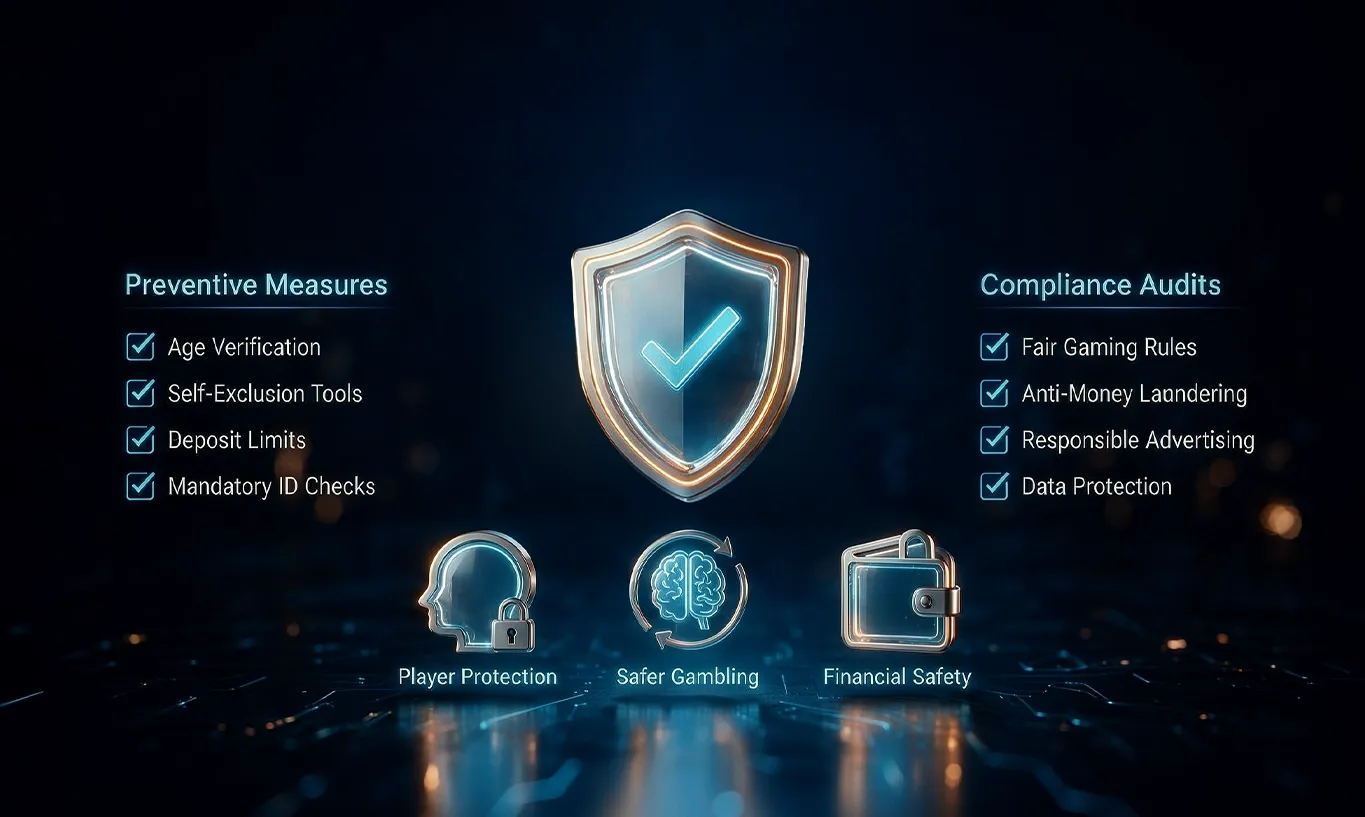
The toolkit below covers what a complete responsible gambling offering looks like in 2026. Not every tool is mandatory in every jurisdiction today. But the regulatory direction is convergent: what the UKGC requires now, the MGA and Gibraltar adopt within a year or two. Building the full set now is cheaper than retrofitting later.
Deposit Limits
Daily, weekly, or monthly caps that the player sets. Once the limit is reached, the system blocks further deposits. Decreases take effect immediately. Increases should include a cooling-off period, typically 24 hours, before they activate.
The UKGC pushed this further. From 30 June 2026, operators must proactively offer the option to set a deposit limit before the first deposit and remind players periodically to review it. That is a front-of-journey interaction now, not a setting buried three menus deep in account preferences.
Session Limits, Loss Limits, Reality Checks
Session limits cap playtime. Loss limits cap cumulative losses within a period. Reality checks are periodic notifications showing how long the session has been running, how much the player has deposited, and their net position. The notification should require the player to actively dismiss it before play continues.
These three measures are designed to complement one another. While each supports player awareness on its own, together they provide timely interventions that encourage players to pause and make informed decisions at key moments during play.
Cooling-Off and Self-Exclusion
Cooling-off is a temporary break, usually 24 hours to 6 weeks. The player cannot deposit or wager. Their account stays open. Existing withdrawal requests should process normally.
Self-exclusion is a serious intervention. The player is locked out for a defined period: 6 months, 1 year, 5 years, sometimes indefinitely. In the UK, that means integration with GAMSTOP. By the end of 2025, 562,000 people had registered. An Ipsos study found 75% of them no longer gamble online. May 2026 set an all-time record for new sign-ups in the lead-up to the World Cup.
The MGA's Player Protection Directive adds a cross-brand requirement: operators with multiple brands must ask the player whether the exclusion applies to all of them. Revoking a self-exclusion requires the player to provide a written explanation, and the operator can reject the request. Cooling-off after revocation: 24 hours for definite exclusions, 7 days for indefinite.
Under the Curaçao LOK, a responsible gaming policy with self-exclusion must be in place before the CGA issues the licence.
Speed Controls
The UKGC banned autoplay on all online gaming products from January 2025. Online slots must run at a minimum 2.5-second game cycle. Non-slot casino games: 5 seconds minimum. In June 2026, the UKGC fined Stakelogic for running slots faster than the standard allows. These are technical rules enforced through the Remote Technical Standards, not guidelines.
Catching What the Player Does Not Report
Every tool above is player-initiated. The player decides to set a limit. The player decides to self-exclude. But the question regulators are now asking is: what are you doing about the player who does not recognise the problem themselves?
That is a harder question, and most operators answer it badly.
Five Markers of Harm (MGA)
The MGA's updated Player Protection Directive, effective January 2024, requires operators to monitor five behavioural categories:
Transactions. A player who normally deposits £50 per month suddenly putting in £500 within a week. Deposit frequency spiking from twice a month to daily.
Time. Session length stretching from 30 minutes to 4 hours. A player who used to log in twice a week now showing up every day.
Patterns. Switching from low-stakes video slots to high-volatility titles. Bet sizes escalating. Rapid game-switching. Chasing losses with progressively larger wagers.
Bonus behaviour. Unusual redemption patterns that suggest the player is using promotional offers to sustain play beyond their means.
Other indicators. Repeated failed deposit attempts. Multiple payment method changes in a short window. Complaints about losses. Requests to reverse withdrawals.
These are not optional suggestions. MGA-licensed operators must implement traceable, automated processes to monitor each one and trigger alerts when thresholds are breached.
Seven Prescribed Indicators (UKGC)
The UKGC goes further. Remote operators must use at least seven categories of prescribed indicators to identify harm. The categories cover similar ground to the MGA markers but add financial vulnerability as a specific dimension. The UKGC has been piloting financial risk assessments using public data to check whether a player's spend is consistent with their likely financial capacity. Thresholds: £500 per month from August 2024, then £150 per month from February 2025. These are not yet permanent rules, but they signal where the regulator is headed.
The Real Problem
Some operators spend six figures on a CRM system, configure it to generate behavioural alerts, and then route those alerts to a shared inbox that nobody checks until Friday afternoon. That is not a technology failure. It is an operational one. The alert fired. The system worked. But there was no human on the other end with the authority, the training, and the time to act on it.
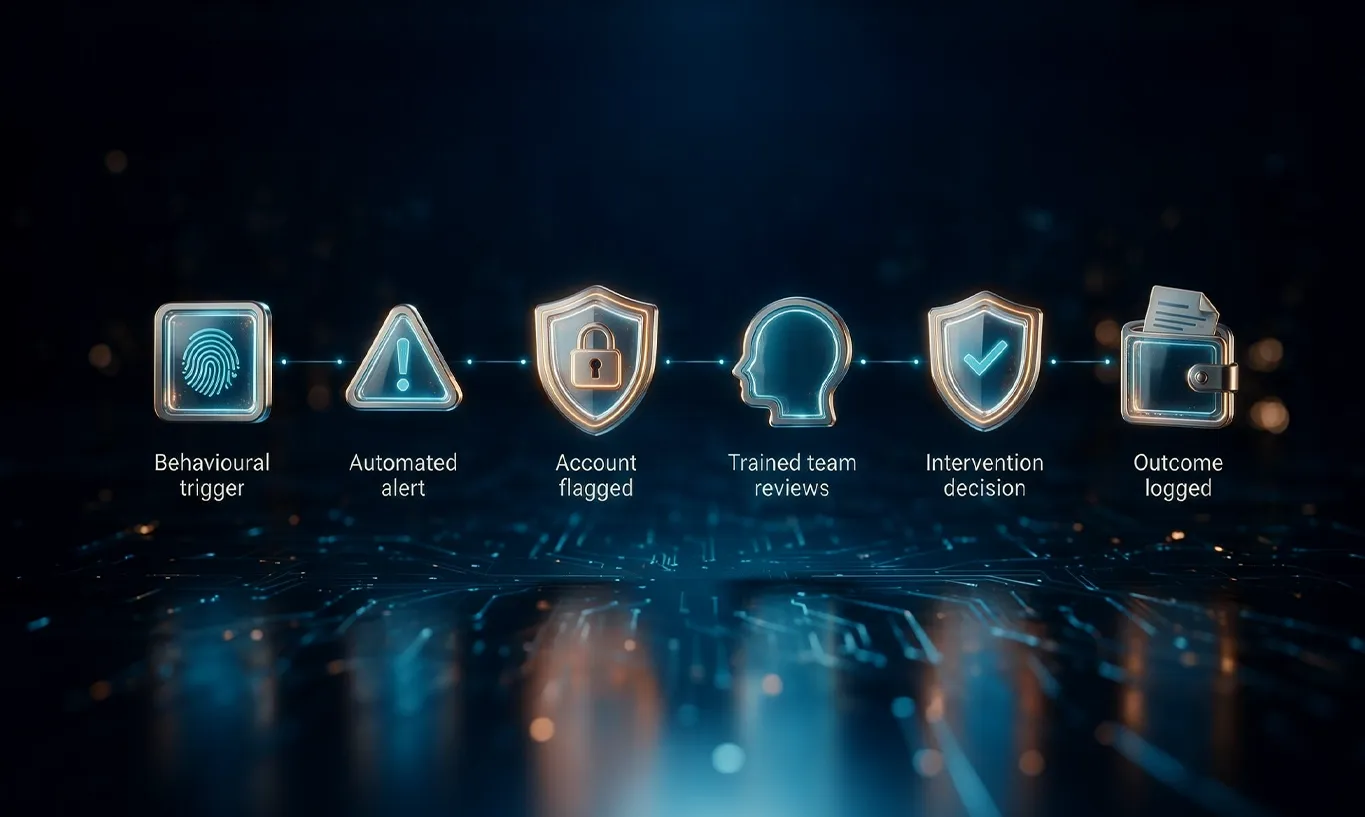
The operators who get this right do something specific. They assign a trained responsible gambling team (even if it is two people in a small operation) with a defined escalation workflow: alert fires, account is flagged within the hour, a trained agent reviews the player's history, makes a decision (contact the player, suggest a limit, impose a cooling-off period, or escalate further), and logs every step. When the regulator asks to see the records, the operator can produce them the same day.
The operators who get fined have a policy document that describes this process beautifully. They just never built it.
What Regulators Fine You For
Reading the regulations tells you what to do. Reading the enforcement actions tells you what operators fail at. The patterns are consistent year after year.
Detection without follow-through. This is the Betfred failure in a sentence: the system flagged the customer, one interaction happened, and then nothing. No follow-up as the player lost £17,900 in 24 hours. The regulator's finding was not a lack of tools but the absence of an effective monitoring framework around them. The difference between having a tool and having a process around that tool is the difference between compliance and a public enforcement statement.
Self-exclusion activation delays. The MGA's 2025 thematic review found that some operators took longer than expected to activate exclusion requests. That delay window is the most dangerous period for a vulnerable player. If your system cannot activate a self-exclusion in minutes, not hours, you have a problem.
Cross-brand leakage. Operators with multiple brands sometimes fail to apply the exclusion across all of them. The MGA review specifically found weaknesses in cross-brand identity matching. A player who self-excluded on Brand A could create a new account on Brand B under the same corporate group using slightly different details. The system did not catch it.
Promotional design that conflicts with player protection. From 19 January 2026, the UKGC limits wagering requirements and bans mixed-product promotions under SR Code 5.1.1. You cannot link casino free spins to betting credits in a single promotional trigger. If your marketing team builds bonuses without checking them against this code, they are creating compliance risk that the compliance team will inherit.
Template policies that nobody follows. Every operator submits a responsible gambling policy during the licensing process. They all read well. The ones that get fined are the ones where the policy describes an escalation process that does not exist, references a responsible gambling team that has not been hired, or cites monitoring thresholds that were never configured in the CRM.
How Responsible Gambling Reduces Costs and Protects Revenue
The cost of a responsible gambling programme, properly staffed, with trained people, configured CRM rules, and documented processes, runs somewhere between £50,000 and £150,000 per year for a mid-size operator depending on the number of markets served. The cost of a single UKGC enforcement action can be ten times that.
But the business case goes beyond avoiding fines.
Players who gamble within their means stay longer. A player who controls their spend, sets sensible limits, and plays for entertainment has a lifetime value measured in years. A player who burns through £5,000 in a week and self-excludes has a lifetime value of one week. Protecting the player is protecting the revenue stream. That is not a feel-good statement. That is arithmetic.
There is a portability argument. An operator who builds a responsible gambling programme to UKGC standards already meets or exceeds the requirements in Malta, Gibraltar, Curaçao, and most other jurisdictions. The investment transfers to every market you enter. Retrofitting does not.
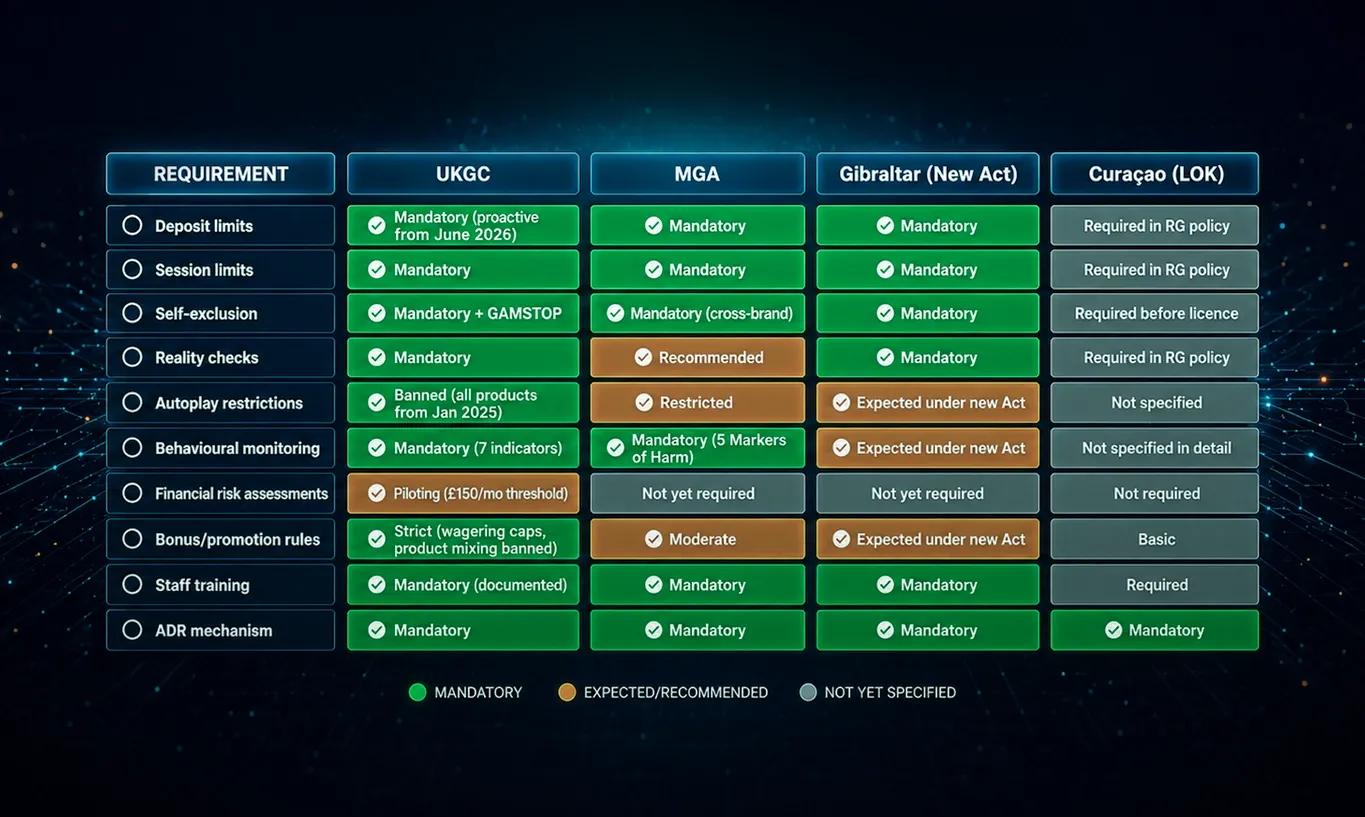
Cross-Jurisdiction Requirements at a Glance
| Requirement | UKGC | MGA | Gibraltar (New Act) | Curaçao (LOK) |
| Deposit limits | Mandatory (proactive from June 2026) | Mandatory | Mandatory | Required in RG policy |
| Session limits | Mandatory | Mandatory | Mandatory | Required in RG policy |
| Self-exclusion | Mandatory + GAMSTOP | Mandatory (cross-brand) | Mandatory | Required before licence |
| Reality checks | Mandatory | Recommended | Mandatory | Required in RG policy |
| Autoplay restrictions | Banned (all products from Jan 2025) | Restricted | Expected under new Act | Not specified |
| Behavioural monitoring | Mandatory (7 indicators) | Mandatory (5 Markers of Harm) | Expected under new Act | Not specified in detail |
| Financial risk assessments | Piloting (£150/mo threshold) | Not yet required | Not yet required | Not required |
| Bonus/promotion rules | Strict (wagering caps, product mixing banned) | Moderate | Expected under new Act | Basic |
| Staff training | Mandatory (documented) | Mandatory | Mandatory | Required |
| ADR mechanism | Mandatory | Mandatory | Mandatory | Mandatory |
Steps to Build a Responsible Gambling Programme
If you are starting from scratch or rebuilding something that exists on paper but not in practice, here is the sequence.
Audit your tools first. Can a player set a deposit limit within two taps from anywhere on the site? Can they self-exclude without calling anyone? Can they find your responsible gambling information page from every screen? If any answer is no, fix that before touching anything else. The MGA Directive requires responsible gambling information to be accessible within one click from anywhere on the platform. Test it on mobile, not just desktop.
Then build the monitoring. Connect your CRM to your player account management system. Define thresholds for each of the MGA's five Markers of Harm. Set up automated alerts. Create the escalation workflow: alert to flag to human review to intervention to logged outcome. Test it by triggering the markers yourself on a test account. If the alert does not reach a real person within the hour, the workflow is broken.
Train your people. Customer support agents handle complaints, withdrawal requests, and account queries. They are also the people most likely to interact with a player in distress. They need to know what to look for, what to say, what not to say, and how to document the conversation. Annual refresher training, documented with attendance records.
Review your promotions. Check every active bonus, free spin offer, and loyalty programme against SR Code 5.1.1 if you operate in the UK. Check them against the MGA Directive if you hold an MGA licence. Promotional design is now a compliance-sensitive activity, not just a marketing one.
Document everything. Every player interaction. Every limit change. Every self-exclusion request and its outcome. Every staff training session. When the regulator shows up, and in 2026 it is a matter of when, not if, you should be able to produce the records that same day.
Test your own systems. Run your own mystery shopping. Create a test account. Trigger the behavioural markers. See if the system catches it. See if a human responds. See if the response is logged. Do this quarterly. The MGA already does it with real mystery shoppers. Better to find the gaps yourself.
The Platform Infrastructure Behind Responsible Gambling
Responsible gambling runs on your CRM, your player account management system, and your marketing tools. If those systems cannot segment players by risk profile, enforce limits in real time, and suppress promotional messages to flagged accounts, the programme cannot function at the level regulators expect.
Digitain's full turnkey solution includes player management, CRM, and bonus tools built for regulated markets. The platform supports deposit limits, session controls, self-exclusion workflows, and player segmentation by risk profile. The same platform enforces deposit and session limits in real time, applies self-exclusion across brands, segments players by risk profile, and suppresses promotional messaging to flagged accounts - the exact capabilities this article argues operators are getting fined for lacking.
Digitain holds licences and certifications across multiple regulated jurisdictions, including Malta (MGA), the UK (UKGC), Romania, Greece, Belgium, Peru, Brazil, and Curaçao. You can see the full list on our licences and certifications page. For operators building or upgrading their responsible gambling systems, having a platform partner whose infrastructure already meets the standard across jurisdictions removes a real chunk of technical and compliance work. If that is where you are, book a responsible gambling gap audit with our team. We will map your current tools, monitoring, and documentation against UKGC and MGA requirements and show you where the holes are.
If you or someone you know is experiencing harm from gambling, help is available. Contact GamCare (UK), the MGA Player Support Centre (Malta), or your local responsible gambling helpline.
Related Articles
How to Get a Gambling Licence: The Complete Guide (2026)
Learn how to get a gambling licence for your iGaming business. Explore licensing requirements, costs, timelines, top jurisdictions, application steps, and ongoing compliance obligations.October 23, 2026Blog
What is a Turnkey Sportsbook Solution? Costs, Features, and Launch Timelines
Learn what a turnkey sportsbook solution includes, how it works, its costs, launch timelines, licensing requirements, and key benefits for operators.October 22, 2026Blog
How Starbucks Turned Coffee Runs into a High-Engagement Loyalty Game
How Starbucks turned its loyalty program into a game with Stars, status levels and bonus days, and what iGaming operators can apply to player retention.October 21, 2026Blog