
Betting Odds Explained: How Sports Odds Work

Betting Odds Explained: How Sports Odds Work
Betting odds are the numbers a bookmaker uses to show two things at once: how likely an outcome is, and how much a winning bet will return.
Take a Wimbledon final between a top seed and an unseeded player. If the top seed is the favourite, the odds on that player will be shorter. If the unseeded player is the underdog, the odds will be longer. The bookmaker is showing, in number form, that one player has a stronger chance of winning than the other.
Betting odds are the operator’s pricing tool. Without understanding them, you cannot control profit, risk, or competitiveness.
This guide explains how sports odds work, how to read each format, how bookmakers set prices, and how to use implied probability to make better decisions.
The Types of Betting Odds
Odds do not come from raw stats alone. Bookmakers look at form, injuries, past results, and other data. Then they react to where the money goes. If a large amount of money is on one side, the price can shift. So odds reflect probability, but they can also reflect market pressure.
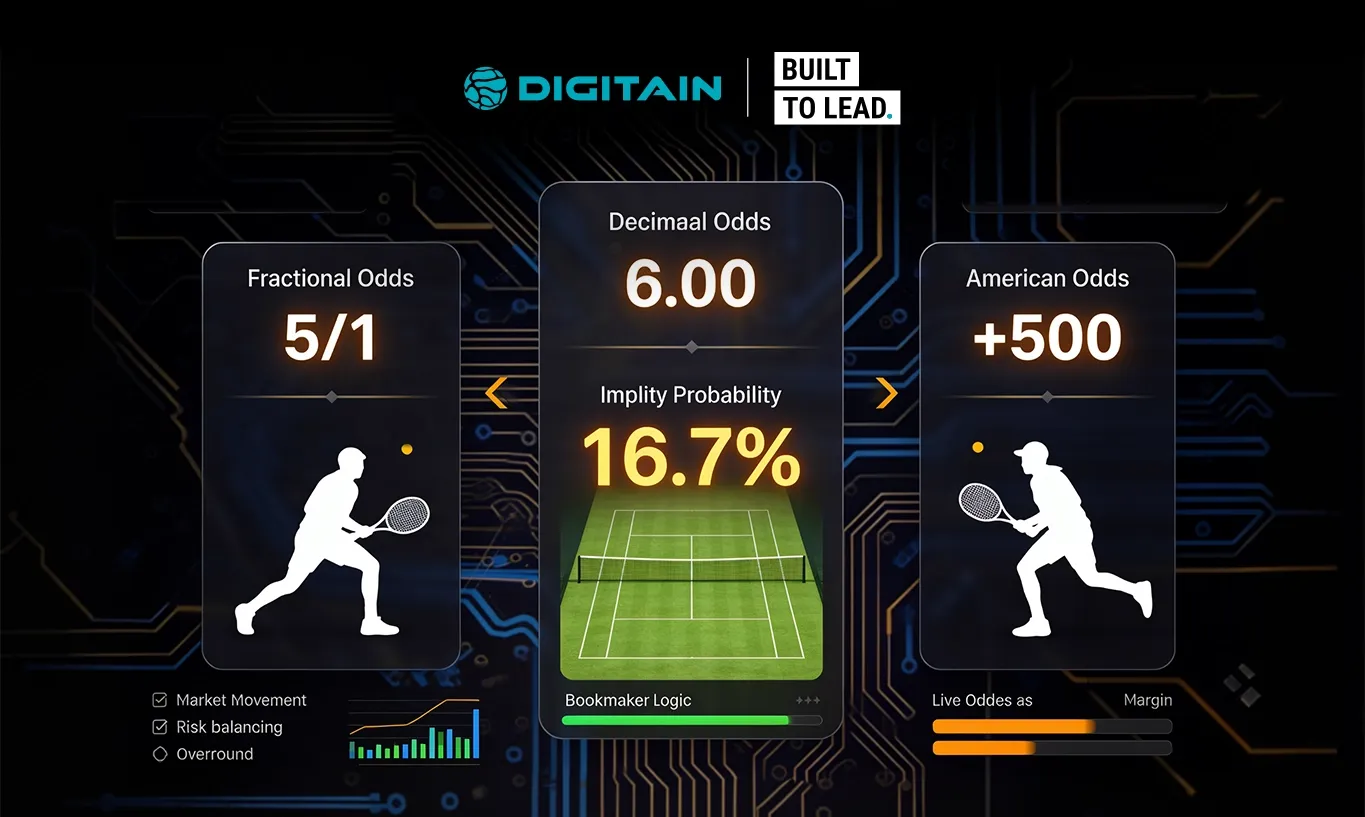
Below are the three main types of odds explained one by one.
Fractional Odds
This is the traditional British format. Fractional odds show profit against stake. In 5/1, the 5 is the profit and the 1 is the stake. A £1 bet wins £5 profit and returns £6 in total.
Profit = Stake x (Numerator ÷ Denominator)
- 2/1: A £1 bet wins £2 profit and returns £3 total.
- 9/2: A £2 bet wins £9 profit and returns £11 total.
- 1/4: A £4 bet wins £1 profit and returns £5 total.
You will often hear the term odds-on. That means the profit is smaller than the stake. At 1/2, you need £2 to win £1 profit, so the total return is £3.
Is 11/8 better or worse than 6/4? You need to do the division in your head. That friction is why the industry has been drifting toward decimal for years.
Decimal Odds
This is the format taking over online betting. Decimal odds show total return per £1 staked, with your stake already included. A price of 3.00 means every £1 returns £3 in total. Your profit is £2.
Total Return = Stake x Decimal Odds
Many bettors like decimals since the maths is quick. If the number is below 2.00, the selection is odds-on. If it is above 2.00, the selection is the outsider.
The same price can be in different formats:
- Fractional 5/1 = Decimal 6.00
- Fractional 1/2 = Decimal 1.50
Once you see that link, the two formats stop feeling like different systems.
Operators often prefer this format too. When a bettor builds a parlay (accumulator), you multiply the decimals together. If you have three bets at 2.00, 1.50, and 3.00, combined odds = 9.00.
American Odds
This is what you will see on international sportsbooks. American odds, often called moneyline odds, use plus and minus figures. A negative number shows how much you need to stake to win £100 profit. A positive number shows how much profit you would win from a £100 stake.
Take -150. You would need to stake £150 to win £100 profit. Take +200. A £100 stake would win £200 profit. A negative number points to the favourite. A positive number points to the underdog.
This format is less common in the UK, yet many international bookmakers and apps still show it. So it helps to know the basics.
Implied Probability: Turning Odds Into Percentages
Implied probability is the chance of an outcome hidden inside the odds. Turning them into percentages gives you a deeper view.
Odds of 5/1, decimal 6.00, and American +500 all describe the same chance. They just write it in different ways. In probability terms, that chance is 16.7%.
All three formats show the same probability and payout, so converting between them is simple maths.
| Conversion | Formula | Example |
| Fractional to Decimal | (Numerator ÷ Denominator) + 1 | 5/2 → (5÷2) + 1 = 3.50 |
| Decimal to American (+) | (Decimal − 1) × 100 | 3.50 → (3.50−1) × 100 = +250 |
| Decimal to American (−) | −100 ÷ (Decimal − 1) | 1.67 → −100 ÷ 0.67 = −149 |
| American (+) to Decimal | (American ÷ 100) + 1 | +250 → (250÷100) + 1 = 3.50 |
| American (−) to Decimal | (100 ÷ |American|) + 1 | −150 → (100÷150) + 1 = 1.67 |
This calculation becomes automatic once you have done it several times.
How Are Sports Odds Set? Inside the Bookmaker’s Process
Bookmakers do not pull odds from thin air. They come from two systems working side by side:
- Odds compilers, or traders, who set the opening prices. They study past results, recent form, head-to-head records, injuries, venue, and weather to determine the most likely outcome before the market opens.
- Automated pricing engines that handle volume and speed. A sportsbook cannot price 180,000+ events a month by hand. Automated pricing tools pull in live data from sources such as Sportradar, Betgenius, and LSports. They run it through in-house models, and update odds across thousands of markets at the same time.
Then they post that first number. Once the odds go live, money matters. If a large amount lands on one side, the bookmaker may shorten that price and push the other side out to keep the book balanced and protect margin.
Take a tennis match. Player A opens at a price that implies 52%. Player B opens at a price that implies 52% too. Add those percentages together, and you get 104%. That extra 4% is the overround, often called the book. It is the bookmaker’s built-in margin.
You will hear the term vig, or juice, in the same conversation. It means the commission hidden inside the odds. A standard spread line of -110 is a good example. A bettor risks £110 to win £100, and that extra £10 is the bookmaker’s cut.
The same logic works for many gaming products. That is why strong back-end systems matter for operators running a sportsbook or a casino.
Why Do Betting Odds Move?
Odds move for three main reasons:
- More money can be placed on one side of the market.
- New information can change the picture.
- Bookmakers can copy or react to prices posted elsewhere.
A short timeline makes this easier to see. When a match opens, Team A might be 2/1. Then news breaks that their top striker is out, so the price drifts to 4/1. Closer to kick-off, strong money comes in from respected bettors, and the odds tighten to 7/2.
Some bettors watch these moves closely. Large bets from sharp punters can shift a line fast, and that can hint at where informed money is going. Opening odds are often less polished than closing odds, since the market has had less time to absorb news and to see betting volume build.
Live betting adds another layer. In-play odds update during the match as goals, red cards, wickets, or break points change the picture in real time. The numbers on screen are never fixed for long.
How Sports Odds Work Across Common Bet Types
Odds only make sense within a betting market, and the market type determines what those numbers represent.
Moneyline or Match Result Bets
This is the simplest market. You pick the winner, or, in football, you may pick a home win, a draw, or an away win. If Manchester City are 1/2 against a lower-table side, the bookmaker sees City as far more likely to win. If the outsider is 11/2, the return is bigger since the result is seen as less likely.
Handicap Betting
A handicap market gives one side a virtual head start or deficit. It makes one-sided fixtures more interesting from a betting perspective. Say Arsenal are priced on a -1.5 goal handicap against a weaker side. A bet on Arsenal wins only if they win by at least 2 goals. The odds reflect that extra challenge, not just the match winner.
Over or Under Bets
This market focuses on a total, not the winner. In football, the bookmaker may set the line at 2.5 goals. You can back over 2.5 if you expect 3 or more goals, or under 2.5 if you expect 2 or fewer. The two prices are often close to evens since the bookmaker tries to split the market as evenly as possible.
Accumulator or Parlay Odds
An accumulator combines several selections into one bet. Each leg must win. In decimal format, you multiply the prices together. If one team is 1.80, another is 2.00, and a third is 1.50, the combined price is 5.40. The return looks attractive, yet the risk increases with each additional leg.
On modern online casino software systems, a user can switch from a football market to blackjack or roulette within a single account and wallet. That makes clear pricing and easy-to-read odds even more useful.
How Sportsbooks Build Their Margin
The overround is the bookmaker’s built-in margin. It is the gap between a fair market and the prices you actually see on the screen. Once you know how to spot it, the maths is quick.
Take a football 1X2 market:
| Outcome | Decimal Odds | Implied Probability |
| Home Win | 2.10 | 47.6% |
| Draw | 3.30 | 30.3% |
| Away Win | 3.50 | 28.6% |
| Total | 106.5% |
A fair market would add up to 100%. Here, the total is 106.5%. The extra 6.5% is the overround.
Overround (%) = Sum of all implied probabilities − 100%
That extra percentage is where the sportsbook makes its margin. It does not mean every bet is bad value. It just means the market is priced in the bookmaker’s favour from the start.
Typical Margins by Market Type
| Market Type | Typical Overround |
| Premier League / Champions League 1X2 | 4–7% |
| Tennis Head-to-Head | 3–6% |
| NFL / NBA Moneyline | 4–6% |
| Horse Racing (10+ runners) | 15–25% |
| Niche Sports / Lower Leagues | 8–12% |
| Betting Exchanges | 1–3% |
| Parlays / Accumulators (effective) | 15%+ (compounds per leg) |
So, a three-leg accumulator with 5% overround on each leg is not a flat 15%. The effect compounds, which often pushes the real margin higher. That is one reason accumulators are so profitable for sportsbooks.
Why Odds Strategy Matters For Operators
Revenue Starts with Pricing
Odds strategy directly affects margin. If a sportsbook runs at an average overround of 5% on £10 million in monthly handle, the theoretical margin sits at about £500,000. That makes the pricing engine a commercial tool, not just a trading function.
One Margin Does Not Fit Every Market
Strong sportsbooks do not apply the same margin across every event and market type. High-profile matches usually need tighter pricing, where users are more likely to spot small gaps. Lower-tier leagues and player props can carry a wider margin, where liquidity is lower and the market is less settled. This gives operators a better balance between betting volume and return.
Format Choice Affects Conversion
Supporting fractional, decimal, and American odds is the starting point. The better move is to match the default format to the player’s region. Decimal works for much of Europe, American suits the US, and fractional still feels familiar to many UK users. It is a small product choice, yet it can make betting feel quicker and more natural from the first click.
Key Betting Odds Terms to Know
- Odds are the numerical expression of an outcome’s chance and the amount a winning bet returns.
- Favourite is the outcome the bookmaker considers most likely to happen. It carries the shortest odds.
- Underdog is the outcome seen as less likely to happen. It carries the longest odds.
- Implied probability is the percentage chance hidden inside the odds.
- Overround or book is the amount above 100% when you add all implied probabilities in a market. That extra percentage is the bookmaker’s margin.
- Vig or juice is the bookmaker’s cut embedded in the price. It is the small edge that helps the sportsbook make money over time.
- Odds-on means the profit is less than the stake. Fractional 1/2 and decimal 1.50 are common odds-on prices.
- Evens means the profit matches the stake. In fractional odds, that is 1/1, and in decimal odds it is 2.00.
- Line movement describes odds changing after a market opens. If the price gets longer, bettors often call it a drift. If it gets shorter, the market has tightened.
- Value bet means a bettor believes the true chance of an outcome is higher than the chance implied by the bookmaker’s odds.
The Bottom Line
Betting odds are a way of combining probability and payout into a single price. Fractional, decimal, and American odds all say the same thing in different formats, and every market includes a bookmaker margin. Once you can read implied probability and spot value, each bet becomes a more informed call.
For operators, the tech behind those prices matters. Digitain’s sportsbook software brings together 1,300+ international traders, a proprietary pricing engine, and real-time data across 180,000+ live events each month.
Teams that want control over layouts, odds settings, and bet limits can connect via the sportsbook API, with live feeds, settlement tools, and built-in risk controls. From launch through global growth, the engine behind the screen is what makes those numbers work.
Share This Article
Related Articles

What Is House Edge in Gambling? A Guide for Operators
Discover how house edge and RTP shape casino and sportsbook margins, player retention, and portfolio optimization in this guide for iGaming operators.September 17, 2026Blog
Turnkey Sportsbook vs. Custom Development: Which Model is Right for You
This guide compares turnkey sportsbook solutions with custom development for operators entering the growing sports betting market.September 10, 2026Blog
How to Start a Crypto Casino in 2026
Looking to launch a crypto casino in 2026? Explore our step-by-step guide covering licensing, software selection, payment gateways, and game integration.September 10, 2026Blog