
Turnkey Sportsbook vs. Custom Development: Which Model is Right for You
Choosing the wrong sportsbook delivery model can delay launch by months and commit the operator to a cost structure that becomes difficult to reverse. The central decision is whether speed and outsourced operations matter more than source-code ownership and long-term platform control.
Grand View Research valued the global sports betting market at $111.2 billion in 2025 and projects it to reach $236.0 billion by 2033. Its current report estimates that Europe represented approximately 48% of global market revenue in 2025. That kind of growth makes every decision high-stakes.
For many teams, the first big choice is simple to state but hard to answer. Should you choose speed with a ready platform, or build your own from the ground up? A misstep here can set you back months. It can cost hundreds of thousands before the first bet is placed on your sportsbook.
This guide gives you a side‑by‑side comparison of costs, time to launch, ownership, compliance, and control. By the end, you will get a clear decision framework you can act on today.
How are Turnkey Sportsbook and Custom Development Different?
Before comparing numbers, we will define the models. Neither model is universally better. Turnkey prioritises speed, lower initial technical investment and outsourced operations. Custom development prioritises ownership and product control, but requires more time, capital and internal capability.
What Is a Turnkey Sportsbook?
A turnkey sportsbook is a pre‑built, ready‑to‑deploy platform. It covers your betting engine, live odds and data feeds, payments, player account management, and risk tools.
A turnkey provider may supply technology with recognised testing certificates, jurisdiction-specific documentation and previously approved integrations. The operator and, where applicable, its technology and service suppliers must hold the licences, registrations, approvals and certifications required in the relevant jurisdiction. Turnkey sportsbook solutions give operators a fast path to market with the key parts already connected and tested: betting engine, live odds, payment gateway, CMS, KYC, and risk management.
What Is Custom Sportsbook Development?
With custom development, a custom-development model can provide greater ownership of the code written specifically for the operator, subject to the development contract. Third-party software, data feeds, cloud services, payment tools and licensed components remain governed by their own intellectual property and usage terms. The contract should define source-code ownership, repository access, documentation, employee and contractor assignments, background IP, open-source obligations and post-termination support. You hire or contract a team, choose the architecture, pass certifications, and run maintenance.
A fully custom sportsbook software stack often includes a proprietary betting engine, trading tools, a payments layer, an account and wallet system, KYC and AML, a CMS, a bonus engine, reporting, and a data warehouse.
The trade‑offs are clear: full ownership and flexibility, with a longer timeline and higher upfront cost.
Advantages of Turnkey Sportsbook Solutions
Turnkey serves operators who want to launch quickly and grow without first building a large tech team. The approach suits single‑brand rollouts, new market entries, and teams focused on acquisition and retention over engineering.
Speed to Market
Turnkey removes the build phase. A turnkey sportsbook can often launch within several weeks when licensing and core integrations are ready. A fully custom sportsbook usually requires a substantially longer development programme and may take a year or more before production launch. A faster implementation can help an operator launch before a major local sporting season or acquisition window that a custom-development programme might miss.
Lower Upfront Investment
Licensing a turnkey platform typically ranges from £11,000 to £60,000, or a monthly SaaS fee. A custom build often needs £110,000 to £370,000 or more before launch. With a turnkey approach, capital stays free for marketing, bonuses, and partnerships. There is no need to recruit engineers and tech staff in‑house on day one.

Integrated Features
You start with a working sportsbook that already includes the essentials. Typical features include:
- Live odds and data feeds
- Payment gateway connections with fraud screening
- KYC and AML checks
- Bonus and loyalty engines
- CMS with localisation support
- Risk control with bet settlement and cash out
Many turnkey operators also get multi‑currency, multi‑language, and affiliate tracking from day one. Operators connect to live markets and third‑party feeds through a proven sportsbook API, which keeps odds, settlements, and payments in sync without building every connector from scratch.
Compliance Tools and Regulatory Implementation Support
Reputable providers keep recognised testing certificates and documentation for multiple territories. Regulatory updates can require changes to promotional logic, account controls, customer communications and reporting. For example, Great Britain-facing operators subject to the relevant LCCP requirements... then explain that a technology provider may assist operators in implementing corresponding platform changes. Vendors update settings, player messages, and reporting templates, then roll the changes across client sites. This ongoing policy work is a hidden cost for custom builds that many teams underestimate.
Pros and Cons of Custom Sportsbook Development
Custom development suits teams that view the platform as a product in itself.
Pros of Custom Development
This model gives you full ownership. You hold the source code, data, and architecture. A custom platform can reduce dependence on a single turnkey provider and avoid a platform-level revenue-share model. The operator may still depend on development partners, cloud infrastructure, sports-data suppliers, payment services and licensed components, each with its own commercial and exit terms. You can shape anything you want. That can mean proprietary market types, gamified bet builders, AI‑driven odds logic, or country‑specific UX that sets your brand apart.
A bespoke sportsbook can also become a B2B asset. Some operators license their proprietary betting platform to others, adding a new income stream. Over the long term, fees are under your control. After the initial outlay is recovered, ongoing costs stabilise against your own budgeting, not a vendor’s pricing model.
Cons of Custom Development
Increasing costs can cut margins. Based on the components listed below, the initial discovery, development, integration, certification and first-year infrastructure budget ranges from approximately £172,000 to £570,000 before the ongoing product team is included. The estimate should be treated as illustrative. Actual cost depends on scope, staffing location, sportsbook-engine complexity, trading model, data contracts, target jurisdictions and the amount of third-party technology used.
Time to market is slow. A 12 to 18-month timeline is common before taking the first wager. That can mean missing seasons and key events.
All licensing and regulatory updates fall on your team, and policy updates never stop. You also carry ongoing engineering overhead: maintenance, security patches, feature work, uptime planning, and hosting at scale.
Projects slip due to scope creep, failed vendor links, or staff churn. Technical debt can arise when early shortcuts are not paid off, leading to delays later.
Comparing Costs of Turnkey and Custom Sportsbook Development
Compare total cost, not only setup cost.
A turnkey commercial model may include: setup or implementation fees; monthly platform fees; minimum commitments; revenue share calculated on a defined GGR or NGR base; managed trading and risk charges; premium data, payment and custom-development fees.
A custom model may include: initial development; permanent engineering, QA and DevOps teams; trading and risk operations; data and odds rights; hosting, security and monitoring; certification, licensing and regulatory updates; ongoing product development.
The crossover point should be calculated using the operator's expected revenue rather than a generic upfront-price comparison.
Indicative formula:
- Annual turnkey cost = fixed platform fees + minimum commitments + revenue-share percentage × contractual revenue base + additional services
- Annual custom cost = engineering + trading + data + hosting + security + compliance + maintenance
- Indicative crossover revenue = (annual custom cost − annual fixed turnkey fees) ÷ revenue-share rate
The calculation must use the contract's precise definition of GGR or NGR, including bonuses, taxes, payment fees, supplier costs, negative carryover and affiliate deductions.
What Does a Turnkey Sportsbook Cost?
Most providers use one of three models:
- Turnkey upfront cost: Varies by commercial model, implementation scope, market and integrations. May include setup, branding, front-end, payment, data and certification charges.
- Monthly or recurring cost: May include fixed SaaS fees, minimum commitments, revenue share and managed-service charges.
- White-label cost: Present separately because it includes a different licensing, operational-control and regulatory-responsibility model.
Extra items can add small fees, such as premium data feeds, additional payment options, or bespoke front-end work.
What Does Custom Sportsbook Development Cost?
Breakdown of the spend across phases:
- Discovery and design: £15,000-£45,000 for product planning, UX, and architecture.
- Core build: £90,000-£300,000 for the betting engine, wallet, back office, and user portal.
- Third-party links: £30,000-£90,000 for payments, KYC, and odds providers.
- Security and certification: £22,000-£75,000 for audits and testing.
- Hosting and operations for year one: £15,000-£60,000 based on scale.
- Ongoing product team after launch: £22,000-£75,000 per month for engineers, QA, DevOps, and support.
Based on the illustrative ranges above, three-year spend could fall between approximately £964,000 and £3.27 million before additional licensing, sports-data, trading and regulatory costs are included. The lower end assumes a £172,000 initial build and a £22,000 monthly product team. The upper end assumes a £570,000 initial programme and a £75,000 monthly team. These figures should not be presented as industry benchmarks without defining the team size, geography, product scope and potential overlap between cost categories.
Time to Market: Turnkey Sportsbook vs. Custom Development
Speed matters when building a sportsbook. Here is how long each path usually takes, and why that gap matters.
Turnkey Launch Timeline
A typical turnkey rollout timeline breakdown:
- Week 1-2: project planning, platform setup and branding
- Week 3-4: payments, KYC and data-feed configuration
- Week 5-6: UAT, responsible-gambling configuration and compliance checks
- Week 7-8: controlled soft launch and production rollout
Digitain provides established sportsbook, payment, KYC and platform integrations, supported by in-house trading and risk-management capabilities. These connections can reduce technical implementation work, although the operator must still complete the relevant commercial agreements, due diligence, market approvals and provider onboarding. Current Digitain product positioning cites 180,000+ monthly live events, 4,000+ betting markets and 1,300+ international traders and risk managers.
Custom Development Timeline
A typical custom rollout breakdown:
- Month 1-2: requirements, product design and architecture
- Months 3-5: core engine, wallet, back office and front-end development
- Months 6-8: payments, KYC, sports data, and supplier integrations
- Months 9-12: QA, security, load testing and certification preparation
- Months 13-18: regulatory completion, production readiness, soft launch and iteration
Timelines often slip by 3-6 months, so 12 months is an optimistic case for most teams.
Why Market Windows Matter
Global events like the World Cup, Super Bowl, and UEFA Champions League drive spikes in viewership. Miss the window, and acquisition costs can increase later.
Market timing should be assessed country by country. In newly regulated or rapidly changing jurisdictions, the commercial window depends on licence readiness, payment onboarding, local sports calendars, media costs and the number of approved competitors.
The Third Option: A Hybrid Approach
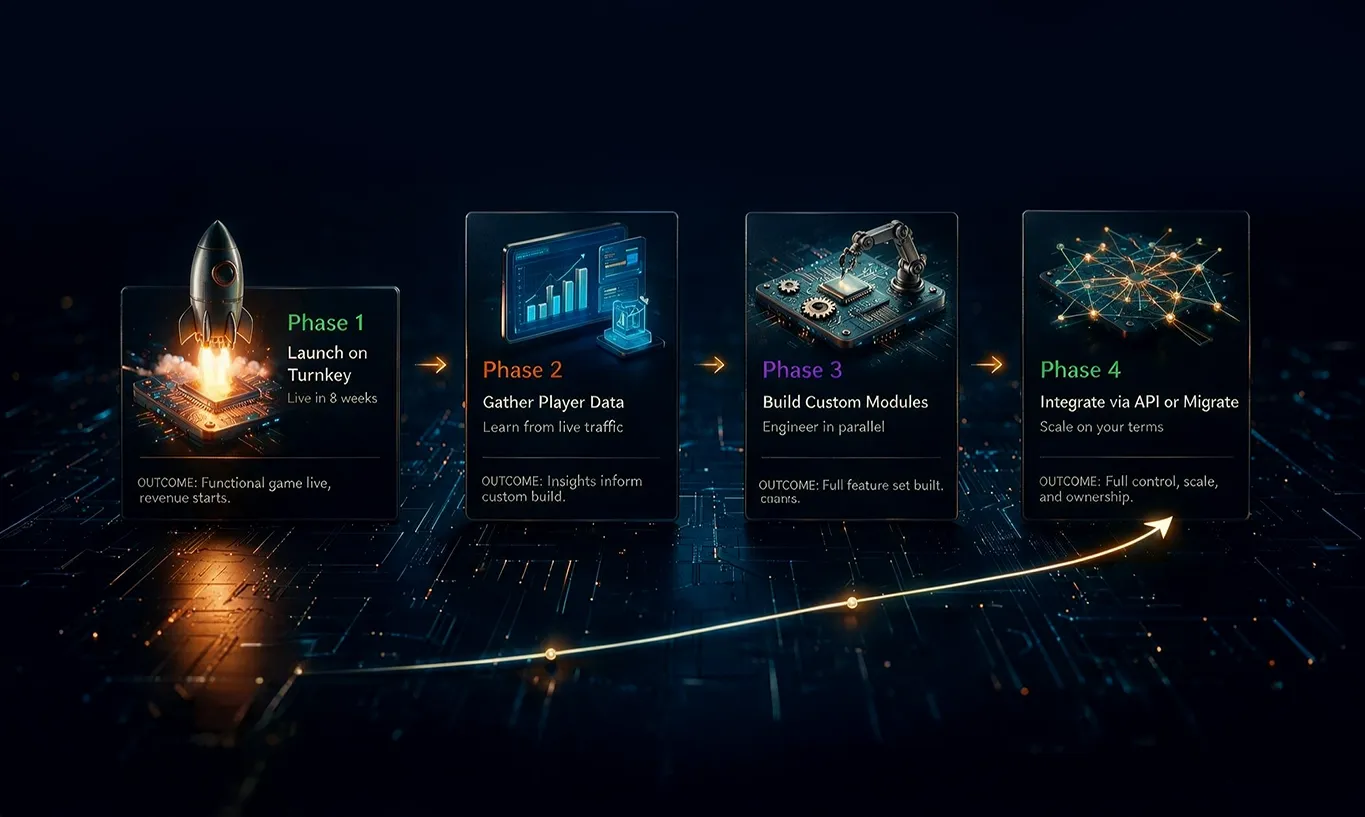
When you choose a model, you do not have to stay with it forever. Many operators launch on a turnkey to win the first season, then add custom components in parallel. Revenue keeps flowing while your product edge takes shape.
How the hybrid model works in practice:
- Phase 1: Launch on a turnkey platform. Start taking bets, grow the brand, and gather player data.
- Phase 2: Analyse what your players want that the base platform does not cover. Think unique bet types, a different loyalty scheme, or new risk models that fit your market.
- Phase 3: Commission custom modules for those needs while you stay live on turnkey.
- Phase 4: Integrate approved custom modules through the provider’s APIs, or prepare a controlled migration where the commercial and regulatory case justifies it.
Digitain's Sportsbook API supports modular integration and gives operators control over selected front-end, odds and betting configurations. The feasibility of adding a custom module depends on the API scope, data model, security requirements and responsibility for settlement, wallet and regulatory controls.
Which Model Is Right for Your Business?
Use this simple matrix to pick a path that fits your plan
Decision Matrix
| Decision Factor | Choose Turnkey If… | Choose Custom If… |
| Budget | ✔ < £75K available ✔ Limited upfront capital ✔ Prefer predictable costs | ✔ £370K+ budget ✔ Long-term ROI focus ✔ Own revenue model |
| Timeline | ✔ Launch in weeks ✔ Licensing deadline soon ✔ Market window closing | ✔ 12–18 months acceptable ✔ Platform as long-term asset |
| Ownership | ✔ Comfortable with SaaS model ✔ Focus on operations | ✔ Full IP ownership required ✔ Multi-brand ecosystem ✔ Proprietary betting tools |
| Team | ✔ No internal dev team ✔ Lean startup structure | ✔ In-house engineering team ✔ Compliance and QA in-house |
Final Words
Turnkey, custom, and hybrid each serve different plans.
- A turnkey model suits operators who want to launch quickly, learn live with real players, and scale with less build risk.
- A custom platform suits teams with a defined product vision, patient delivery timelines, and the funding to create a long-term asset they fully own.
You can start with a turnkey model that lets you go live now, then add or migrate bespoke modules over time to gain deeper control without pausing revenue.
Digitain’s sportsbook combines platform technology, API integration, in-house trading and 24/7 risk-management support across 180,000+ monthly live events and 4,000+ markets. Request a model-specific assessment based on your target jurisdictions, launch date and projected scale.
Share This Article
Related Articles

How to Start a Crypto Casino in 2026
Looking to launch a crypto casino in 2026? Explore our step-by-step guide covering licensing, software selection, payment gateways, and game integration.September 10, 2026Blog
How to Get a UK Gambling Commission (UKGC) Licence in 2026
How to get a UKGC licence in 2026. Licence types, fees, the 40% Remote Gaming Duty, PML requirements, application process, and realistic costs explained.September 3, 2026Blog
Responsible Gambling: Best Practices for iGaming Operators
How to build responsible gambling into your operation. Tools, regulatory requirements, enforcement trends, and practical steps for B2C operators.September 3, 2026Blog