
iGaming Platform Migration: Switch Without Losing Momentum
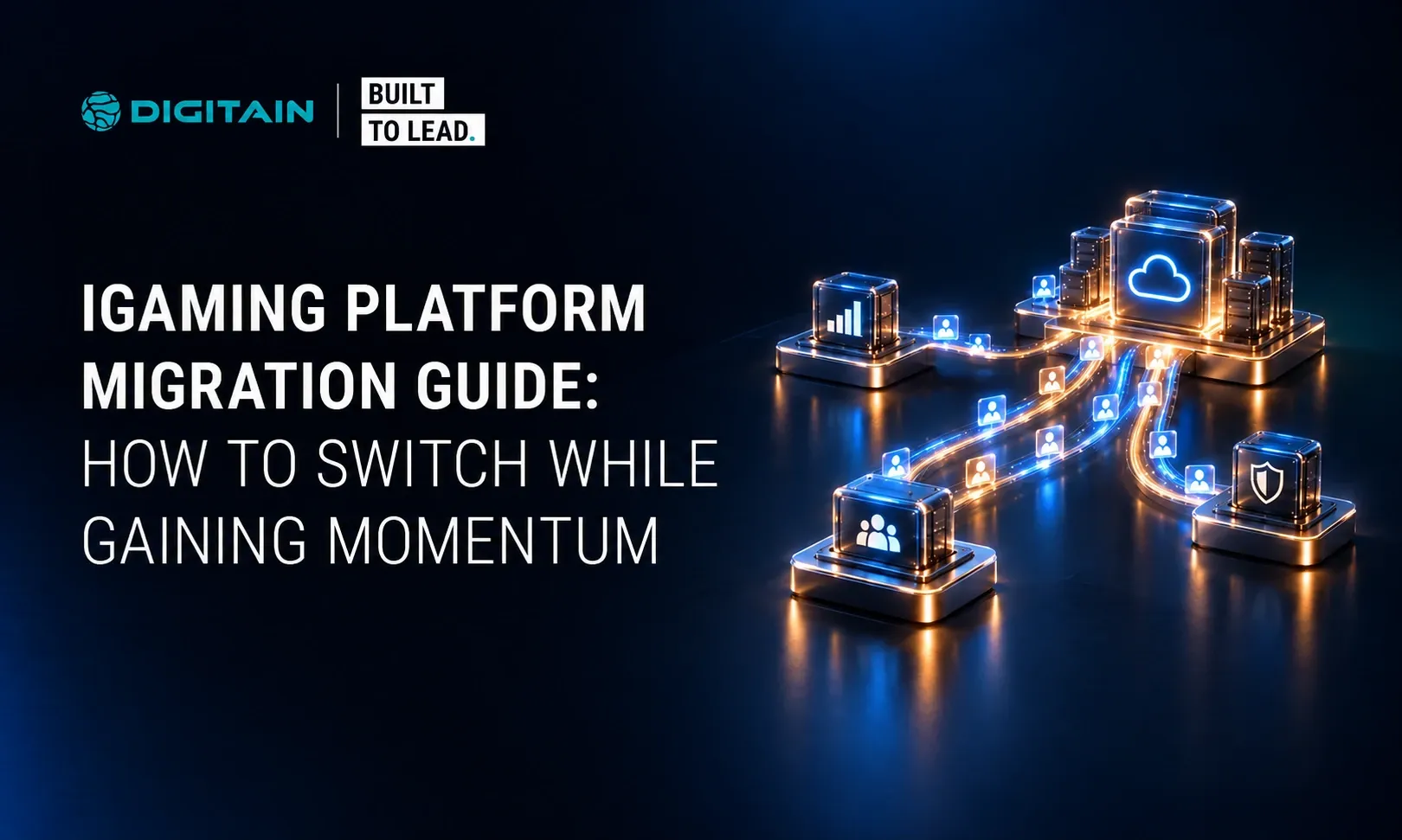
Changing an iGaming platform is one of the biggest operational decisions an operator can make.
You are not simply replacing technology. You may be moving players, balances, transaction histories, betting activity, bonuses, payment connections, integrations and the workflows your teams rely on every day.
That is why you should treat iGaming platform migration as a controlled business transition rather than a standalone IT project. The objective is simple: protect what already works, minimise disruption, and create a stronger foundation for future growth.
When Is It Time to Switch iGaming Platforms?
Operators rarely decide to migrate because of one isolated problem. More often, limitations accumulate until the existing platform begins to restrict the business. If you notice your infrastructure showing signs of fatigue as your business grows, it may be time to consider a move.
Your Platform Is Slowing Growth
More players, products, events, and markets place greater pressure on the underlying infrastructure. A platform that was suitable for an operator at an earlier stage of its development may eventually struggle to support increased traffic, transaction volumes, new products, or more complex operational requirements.
You may encounter limitations around:
- Peak traffic
- Product launches
- Sportsbook performance
- Transaction volumes
- New integrations
- Back-office workflows
- Brand launches
If the technology cannot scale alongside the operation, switching iGaming platforms can become a strategic requirement rather than a technical preference.
Digitain’s iGaming platform combines player management, product management, payments, campaigns and operational tools within one environment.
Bonus and Engagement Tools Are Too Restrictive
Marketing teams need the flexibility to respond quickly to player behaviour.
Rigid bonus logic can slow down:
- Acquisition campaigns
- Retention activity
- Personalised promotions
- Sportsbook offers
- Casino bonuses
- Loyalty programmes
When every adjustment requires additional development or external support, the platform begins influencing how quickly the commercial team can act.
Entering New Markets Is Becoming Difficult
Expansion can expose infrastructure limitations quickly. New markets may require different payment methods, currencies, player journeys, compliance requirements, and product configurations.
A good casino platform migration strategy should therefore consider more than today's requirements. Operators should ask whether their next platform can support the markets, brands, and products they want to launch tomorrow.
The Cost of Staying vs. the Cost of Moving
Migration has an obvious cost. Staying on infrastructure that no longer fits the business has a cost too. It can appear through:
- Slower launches
- Increased manual work
- Limited payment coverage
- Reduced promotional flexibility
- Delayed integrations
- Dependence on provider support
- Difficulty expanding internationally
These problems may seem manageable individually. Over time, however, the opportunity cost can become significant.
A migration decision should therefore compare the risks of changing platforms with the commercial impact of remaining where you are.
The Main iGaming Platform Migration Risks
Every migration involves risk. The objective is not to eliminate every possible risk. You need to identify those risks early and build the migration process around them. This requires a clear understanding of the data being moved, the systems connected to the platform, the teams affected by the change, and the potential impact on players.
Data Integrity
Data sits at the centre of iGaming platform migration. Depending on the migration scope, operators may need to transfer or retain access to:
- Player accounts
- Credentials
- Balances
- Deposits
- Withdrawals
- Transaction history
- Betting history
- Player segments
- Bonuses
- Wagering progress
- Loyalty information
Each dataset requires clear mapping and reconciliation rules. If a player's balance is 100 before migration, it needs to remain 100 afterwards. The same principle applies to every financially or operationally important record.
Technical Dependencies
An iGaming operation rarely consists of one isolated system. The platform may connect with a wide network of third-party technologies and services, each of which can introduce its own migration requirements.
Here is what the platform may connect to:
- Payment providers
- Game suppliers
- CRM systems
- KYC tools
- Affiliate platforms
- Reporting solutions
- Fraud systems
- Sportsbook software
This makes the sportsbook provider migration process particularly sensitive. Betting, settlement, risk management, and real-time information need to remain coordinated during the transition.
Operational Disruption
A technically successful migration can still create operational problems if teams are not prepared for the new environment. Customer support teams may face new workflows, marketing teams may need to relearn campaign tools, finance teams need reliable reconciliation, and trading and risk teams need confidence in the new environment.
Migration needs involvement from the teams that will actually use the platform after go-live. Their input can help identify workflow gaps before launch, and ensure that the new system supports the way the business operates in practice.
Player Trust
Players experience migration through the services they use every day. Problems with login, balances, payments, bonuses, or betting can affect confidence immediately, particularly when players do not understand why something has changed.
The best migration is one that creates as little visible disruption as possible. Maintaining familiar player journeys where practical, validating balances and payment flows, and resolving potential issues before launch can help protect continuity throughout the transition.
Nothing Left Behind
A platform switch should not feel like rebuilding the operation from zero. The principle should be continuity: you should handle all existing players, financial information, betting activity, and relevant account data according to a clearly defined migration scope, with every important dataset accounted for before the switch takes place.
Players and Accounts
You should map player records correctly so existing users can continue interacting with the brand with minimal friction. This includes understanding how account information and credentials will be handled in the new environment.
Balances and Transactions
Balances should be reconciled before migration and validated again after transfer.Transaction history is equally important. Deposits and withdrawals support financial reconciliation, customer support, risk management, and player analysis.
Betting History
Relevant betting records should remain available according to the agreed migration scope. This may include historical betting information as well as open bets that require special handling during cutover.
Bonuses and Loyalty
Active bonuses can be more complex because different platforms may structure bonus logic differently. The migration team should establish early whether bonus balances, wagering progress, expiry rules and loyalty status can move directly or need alternative treatment.
Choosing the Right Migration Approach
A useful iGaming migration guide should distinguish between two broad approaches. The appropriate model depends on your technology stack, migration scope, risk profile, products, and operational requirements
Big-Bang Migration
With a big-bang approach, the old environment is replaced by a new one within a defined cutover window. It can be appropriate in some cases, but it concentrates more risk into one event.
However, it concentrates more risk into one event. More systems, data and teams need to be ready at the same time, making preparation, testing, communication and rollback planning particularly important.
Phased Migration
A phased approach allows products, systems, or workloads to move according to an agreed schedule. Where technically appropriate, old and new environments may also operate in parallel while teams validate functionality and data.
For operators researching how to migrate online casino software without downtime, phased cutover and parallel operation can help reduce disruption. The exact approach, however, depends on the existing technology, integrations, and migration scope.
A Step-by-Step Migration Framework
Although every operator is different, a structured migration generally follows several core stages. Defining these stages before the project begins helps teams understand responsibilities, dependencies, and decision points throughout the transition.
1. Discovery
The first stage is understanding the existing operation. Before any data is moved or systems are rebuilt, teams should establish what currently exists, how different systems interact, and which processes depend on the current platform.
They should map:
- Databases
- Products
- Integrations
- PSPs
- Bonus structures
- Reporting tools
- Player records
- Operational workflows
- Third-party systems
Undocumented legacy integrations are particularly important. Discovering them late can delay the entire migration.
2. Data Mapping and Gap Analysis
Next, teams establish how information moves from the source platform into the new environment. This is where differences between the two platforms become clear and where decisions need to be made about data transformation, retention, and archiving.
Questions include:
- Which fields map directly?
- Which need transformation?
- What historical information needs migration?
- What can remain archived?
- How will balances be reconciled?
- How will open bets be handled?
- What happens to active bonuses?
3. Build and Integration
The new environment can then be configured around the operator. This may include the front end, payments, casino content, sportsbook, CRM, reporting, back-office permissions, and third-party integrations.
For operators migrating to a wider Turnkey Solution, several connected systems may be implemented as part of the same programme.
4. Rehearsal and Testing
Migration should be tested before production cutover. Rehearsals provide an opportunity to identify data discrepancies, integration problems, and operational bottlenecks while there is still time to correct them.
Rehearsals help validate:
- Data transfer
- Reconciliation
- Integration behaviour
- System performance
- Migration speed
- Recovery processes
Testing with realistic data volumes is particularly important.
5. Go-Live
Before the switch, everyone should understand the conditions for launch and the responsibilities attached to each workstream. This includes:
- Who approves go-live
- Which tests must pass
- What triggers a delay
- Who owns each workstream
- What the rollback process is
A controlled go-live depends on clear responsibilities.
6. Post-Launch Validation
The project does not end when the new platform becomes available. The period immediately after launch is essential for confirming that systems, data and operational processes are working as expected.
Teams should continue monitoring:
- Balances
- Payments
- Player accounts
- Sportsbook activity
- Bonus states
- Transaction records
- Reporting
- Integrations
Migration is complete when the system is stable, and the data has been properly reconciled.
Protecting Revenue During Migration
Avoiding GGR loss during platform switch requires more than keeping downtime low. You also need to protect the payment flows, player journeys, and commercial activity that generate revenue throughout the transition.
Protect Payment Flows
PSPs may require endpoint changes, testing, or additional configuration. Payments should therefore be addressed early in the migration programme rather than treated as a final integration task.
Protect Player Journeys
Avoid unnecessary changes to familiar journeys where possible. Unexpected password resets, incorrect balances, or payment problems can create immediate friction, particularly during a period when players may already notice changes to the platform.
Timing also matters. High-value sporting events or major promotional periods can increase migration risk, so the cutover schedule should reflect the operator's commercial calendar. Where possible, teams should avoid introducing additional operational pressure at the same time as the platform transition.

Do Not Forget SEO
If migration also changes the public website, organic visibility needs protection. An iGaming site migration SEO checklist should cover:
- URL mapping
- 301 redirects
- Metadata
- Internal links
- Canonical tags
- XML sitemaps
- Robots.txt
- Tracking
- Affiliate landing pages
- Post-launch indexation
A well-planned 301 redirect strategy for online casino migration helps prevent valuable URLs from disappearing after launch.
Similarly, preserving casino organic rankings during migration requires SEO, content, and development teams to coordinate before the switch rather than reacting afterwards.

Migration Is a Business Project
One of the most common mistakes is giving sole ownership of migration to IT. The technical team may execute the switch, but the entire organisation has to operate the new platform.
Migration planning should involve relevant representatives from:
- Technology
- Product
- Operations
- Payments
- Trading
- Marketing
- CRM
- Customer Support
- Compliance
- Finance
Training should also begin before launch.
A powerful new back office delivers little value if the teams using it do not understand how to take advantage of it. This is also where the relationship with the new platform provider becomes important.
The right partner should support the operator beyond implementation, helping teams understand the technology, optimise the operation, and identify future opportunities.
Common Platform Migration Mistakes
A strong iGaming platform migration checklist should help operators avoid four particularly common mistakes. These issues are often less about the technology itself and more about how the migration is planned, communicated and managed across the organisation.
Treating Migration as an IT-Only Project
Commercial and operational teams need to be involved from the beginning. They understand the workflows, player journeys, and business requirements that may not be visible from a purely technical perspective.
Migrating Everything Automatically
Not every historical record needs to sit inside the active platform. Some information may be better preserved through an accessible archive. The important point is to make this decision deliberately, based on operational, regulatory, financial, and player-support requirements.
Underestimating Third Parties
Payment providers, game suppliers, regulators and other partners may have their own lead times, testing requirements and technical dependencies. These external timelines should be included in the migration plan from the beginning rather than added after the core platform work is complete.
Calling Go-Live a Success
Go-live means the new system is running. Migration success means players can continue using the service; balances are accurate, data is reconciled, and internal teams can work effectively. You need to measure a successful transition beyond the moment when the new platform becomes available
Measuring Migration Success
The value of migration should become clearer after launch. You can evaluate the results across three areas: financial, operational, and growth.
From a financial perspective, this can include GGR, player retention, payment performance and operational cost, helping determine whether the migration has protected revenue while improving efficiency.
From an operational perspective, you can assess campaign launch speed, integration time, support resolution, manual workload, and reporting efficiency. These measures can show whether teams are able to work more effectively in the new environment.
From a growth perspective, you can look at new-market launches, additional payment integrations, new brands, promotional flexibility, and product expansion. These indicators help demonstrate whether the new platform is creating more room for the business to develop.
The real value of migration is therefore not simply how quickly the platform switch happens. It is what the operator can do afterwards.
From Migration to Growth
The safest migration is one players barely notice. The most valuable migration is one the business notices afterwards. Faster changes. Better control. More flexible promotions. Stronger payment coverage. Greater player visibility. More room to expand.
When evaluating how to switch online casino platform providers, you should therefore ask two sets of questions.
First:
What will move?
How will it move?
How will it be verified?
Then:
What will we be able to do once we arrive? Because migration should protect the operation you have today while giving you a stronger foundation for the business you want to build tomorrow.
Ready to Explore Platform Migration?
Digitain supports operators across the migration journey, from planning and data transfer to platform implementation and ongoing partnership.
CTA: Talk to Our Team
FAQ
How long does an iGaming platform migration take?
There is no universal timeline. It depends on the operator's products, integrations, data volumes, infrastructure, and customisation requirements.
Can an online casino migrate without downtime?
Migration should be designed to minimise disruption. Phased cutover, testing, and parallel operation may help, depending on the operator's existing architecture.
What data can be migrated?
Potential data may include player records, balances, transactions, betting history, segments, and bonus information. The exact scope should be confirmed during discovery and data mapping.
Can active bonuses be migrated?
It depends on how bonus logic is structured on the existing and destination platforms. Bonus states and wagering progress should therefore be assessed during migration planning.
When should an operator consider changing platforms?
Typical signs include slow product changes, limited scalability, payment restrictions, inflexible bonus tools, difficulty entering new markets, and increasing reliance on manual processes or provider support.
Share This Article
Related Articles

How Long Does It Take to Launch a Turnkey Sportsbook?
Learn how long it takes to launch a turnkey sportsbook, from setup and licensing to payments, testing, and go-live, plus common delays.September 25, 2026Blog
Betting Odds Explained: How Sports Odds Work
How do betting odds work? Learn fractional, decimal and American formats, how bookmakers set odds, and what implied probability means for operators.September 18, 2026Blog
What Is House Edge in Gambling? A Guide for Operators
Discover how house edge and RTP shape casino and sportsbook margins, player retention, and portfolio optimization in this guide for iGaming operators.September 17, 2026Blog