
How Long Does It Take to Launch a Turnkey Sportsbook?

Many teams expect a turnkey sportsbook to mean signing a contract and going live within a few weeks. In practice, you still need licensing, platform configuration, testing, and payment integration to launch your sportsbook. The gap between “quick and simple” and the steps operators need to take is why timelines often stretch.
In this guide, you will learn how long it takes to launch a turnkey sportsbook, what controls the timeline, how the process works, and common delays to watch for.
Typical Timeline: From Agreement to Live Sportsbook
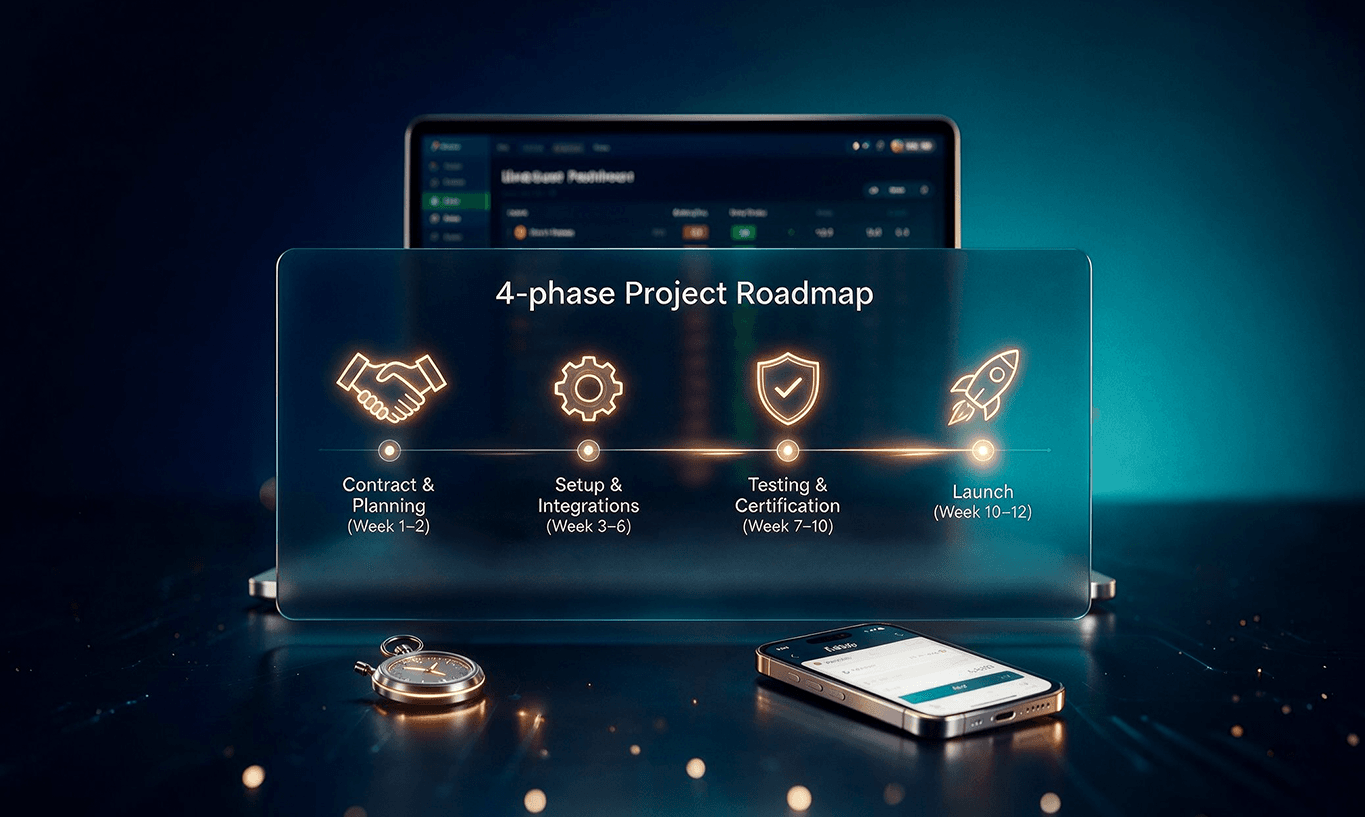
Image Concept: Horizontal 4-phase timeline visualizing the table — Contract & Planning (Week 1–2) → Setup & Integrations (Week 3–6) → Testing & Certification (Week 7–10) → Launch (Week 10–12). Each milestone with an icon (handshake, gear, checkmark, rocket) and a 1-line key activity below.
Based on Digitain’s standard implementation framework, a straightforward turnkey sportsbook project can typically be planned within a 6-to-12-week window, subject to licensing, payment onboarding, certification and agreed scope. Simple projects with fast approvals can go live in about 4 to 6 weeks. Multi-market projects with stricter licensing requirements can take 3 to 6 months.
| Phase | Timeline | Key Activities | What to Watch |
| Contract and Planning | Week 1–2 | Commercial terms close. Scope and project plan confirmed. Access to staging and documentation is shared. Brand assets, domain details, and payment partner list provided. Licensing steps begin. A kickoff call aligns roles and sign-offs. | Clear responsibilities and early licensing progress keep things smooth. |
| Setups and Integrations | Week 3–6 | Sportsbook, player accounts, bonus rules, and content structure configured. Front-end branding added to staging. Payment connectors integrated and tested. Odds feeds and trading profiles activated. User flows reviewed. Support scripts and FAQs prepared. | Payment setup and early testing reduce surprises later. |
| Testing and Certification | Week 7–10 | Cross-device and market testing. Regulator or lab checks (if required). Legal team finalises licence items. Payment partners complete reviews. Marketing tracking approved. Back-office staff training completed. | External approvals often set the pace here. |
| Launch | Week 11–12 | Soft launch to limited users. Monitor deposits, withdrawals, settlements, and support tickets. Apply fixes and content updates. Full launch with live campaigns. The first month focuses on stability and customer care. | Stability first. Scale second. |
What Steps are Involved in Launching a Turnkey Sportsbook?
Below are the steps from contract to launch in the order they happen. Follow them to plan work in the right order.
Step 1: Choosing a Turnkey Sportsbook Provider
Choose a provider with live references in your target market, stable payment and identity integrations, a proven bet engine, and clear documentation. Shortlist two or three vendors, see demos of the back office, trading tools, player accounts, bonus setup, and content management.
Ask for their existing integrations, supported markets and languages, and lead times by jurisdiction. Agree early on who does what.
Step 2: Licensing and Regulatory Setup
The operator must hold, or legally operate under, the required authorisation for the target market. Depending on the jurisdiction, the technology supplier may also require a B2B or gambling-software licence, while the sportsbook platform may require market-specific testing or certification. If you already hold a licence, timelines shorten. If you do not have it, you will need to apply for it.
Appoint key persons as needed, and submit documents on the company structure, source of funds, policies, and technical controls. The provider supports technical questions and supplies certification packs, security reports, and game or sportsbook certifications where relevant.
Your legal team or consultant handles filings and regulator communication. In some jurisdictions, a white-label arrangement can provide a faster route to market by allowing the brand to operate within a licensed operator’s regulatory framework. However, the licence holder retains regulatory responsibility, and the brand may have less control over product configuration, commercial terms, customer data and future migration. Others require a full licence, which takes longer. Start this process as soon as you can.
Step 3: Platform Configuration and Branding
Once contracts are signed and licensing is in progress, the provider configures your platform. This includes your domains, site structure, languages, currencies, odds format, bet limits, bonus rules, and risk settings. You approve templates, colour palette, navigation, and content placements.
Many turnkey systems include a theme editor, so front-end work can be finished without custom code. Keep the first release tight. Launch with a focused brand package, clear home page sections, simple promotions, and a compact sitemap. Add extras after go-live. This approach saves time and avoids redesign loops.
Step 4: Payment Integrations
Set up accounts with chosen acquirers and wallets. The provider will connect the platform to each payment method from a pre-built list. Some local methods require compliance checks, contracts, and test transactions before going live.
Prepare KYC documents for payment partners well in advance. Decide on deposit and withdrawal limits, fees, accepted currencies, and allowable payment combinations.
If you plan to serve multiple regions, stagger payment rollouts by market. It is faster to go live in one market with two or three strong methods than to wait for a long list to be ready.
Step 5: Odds Feed and Risk Management Setup
With a turnkey setup, the provider supplies odds feeds, market templates, live trading tools, and automated rules. They also configure trading profiles, payout caps, cashout rules, and risk alerts. You choose the sports and leagues and set margin targets.
With Digitain’s managed trading services, in-house teams operating around the clock combine algorithmic pricing, real-time data and risk-management controls to support odds management, exposure monitoring and liability control across major events and time zones. If you prefer an in-house trading team, you will receive tools, feeds, and controls, and you will handle market moves. This choice impacts launch speed and team needs.
Step 6: Testing and Certification
Before you accept real bets, the site must pass internal testing and, in many cases, external lab checks. The provider runs platform tests for registration, login, deposit, withdrawal, bet placement, settlement, bonuses, and reporting. Your team reviews user flows and branding.
Keep your test cases short and realistic. Focus on the main flows that matter on day one. Extra features can follow in planned updates.
Step 7: Soft Launch
Before the official launch, start with a soft launch. Open your platform to a limited audience, monitor player behaviour, payments, and bet settlement. Watch error logs and response times. Gather feedback from customer support and your VIP or beta testers. Fix the issues and then open it to the wider market.
This plan protects your brand and keeps your team focused on the right issues in the first weeks.
Can a Turnkey Sportsbook Be Launched Faster Than Custom Development?
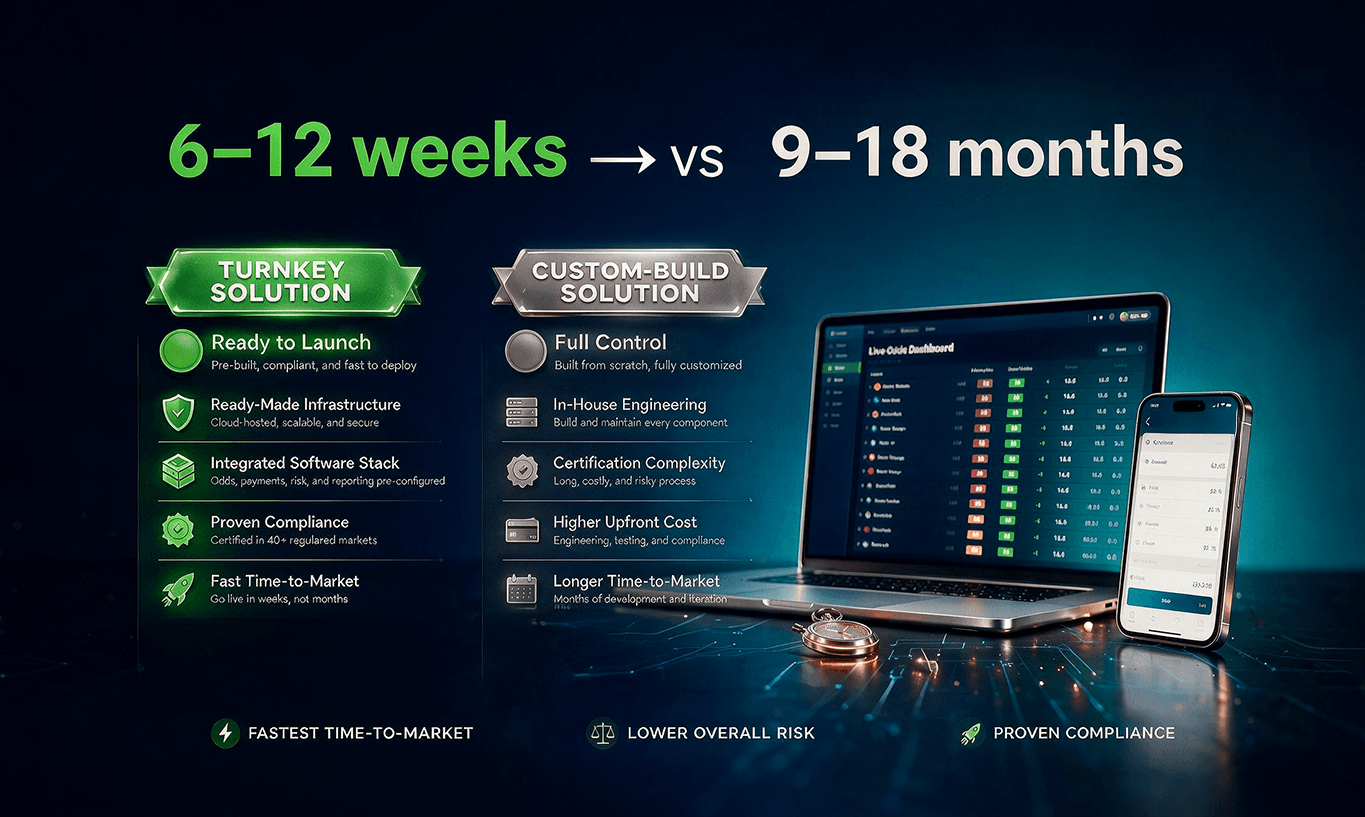
Image Concept: Side-by-side split graphic — Turnkey column (6–12 weeks, highlighted in brand green) vs Custom Build column (9–18 months + certifications, neutral grey). Time comparison dominant at top, 4–5 supporting bullets each (ready infrastructure, integrated software, proven compliance vs in-house engineering, higher upfront cost, longer certification cycles).
In most cases, yes, by a wide margin. A typical turnkey launch takes 6 to 12 weeks, with outliers depending on jurisdiction and the payment partner's speed. A custom sportsbook normally takes substantially longer than a turnkey implementation because the core platform, integrations, testing and certification work must be completed before launch., then more time for certifications and payment work. That makes sense only for certain operators.
Why turnkey wins on speed:
- Ready infrastructure. Hosting, scaling rules, monitoring, and disaster recovery plans from day one.
- Integrated sportsbook software. Odds feeds, market templates, bet types, settlement logic, and cashout flows are already built and tested.
- Proven back-end systems. Player accounts, wallet logic, KYC flows, AML checks, fraud tools, bonus engines, and reporting dashboards are already wired together.
- Digitain’s sportsbook has been assessed against recognised technical standards, including GLI-19 and GLI-33, and has obtained jurisdiction-specific licences and certifications in selected regulated markets. Existing technical documentation can support new applications, although each market may require additional testing or approval.
Custom development may be appropriate for operators that require full control over architecture, product roadmaps, proprietary pricing models and data infrastructure. It can also reduce dependence on a single technology vendor. However, the operator assumes responsibility for development, testing, certification, maintenance, security, integrations and long-term platform support.
That option is suitable if you plan to implement very distinct features or a new pricing engine. The trade-off is time, higher upfront cost, and a heavier support load. Many operators start with a turnkey approach, then add custom modules over time once revenue stabilises.
What Are Common Delays in Sportsbook Rollout?
Delays rarely come from the core platform. Most issues come from approvals, contracts, or internal decisions. Planning for these saves weeks.
Licensing Approval Delays
Every market moves at its own speed. Some regulators process applications in a few weeks. Others take months. Hold-ups often relate to document gaps, background checks, or changes in local rules. Keep a checklist of required documents and assign an owner to each item. Start compliance workshops with your provider early, so technical sections land correctly the first time.
Payment Provider Setup
Acquirers and wallets run checks on your company, markets, traffic plans, and risk controls. Legal review and underwriting can push timelines if documents or site content are not aligned with payment rules. Share your projected monthly volume, expected chargeback rate, accepted regions, and KYC policy in a single pack. Match website content to payment partner content rules before review begins.
KYC and AML Verification Setup
Identity and risk checks often need test cycles with your chosen vendors. False positives, document capture issues, or flow friction can delay sign-off. Design the KYC journey to meet all applicable identity, age, sanctions and AML requirements from launch. Remove unnecessary duplication and test the user experience carefully, but do not postpone mandatory verification or risk controls. Apply additional due-diligence measures whenever the customer or transaction risk requires them.
Local Regulatory Requirements
Some markets require jurisdiction-specific certification of the sportsbook or event-wagering system, together with approved responsible-gambling, reporting and complaint-handling controls. Get a list of market-specific items at project start. Ask your provider which parts are ready and which parts need configuration.
Internal Decision Slowdowns
Long review cycles for logos, landing pages, and promotions are common blockers. Set a strict design freeze date and stick to it. Keep the first version of your sportsbook clean and focused. Extra pages, campaign microsites, and multiple language variants can follow.
Insufficient Operational Planning
Customer support, trading oversight, risk thresholds, and payment ops need clear owners. Delays spike as teams are still forming near go-live. Hire or assign roles early. Create a runbook for the first 30 days covering shifts, escalation steps, and incident contacts.
Most of these delays lie outside the software provider's control. Your team can prevent slippage by locking decisions early, sending complete documents, and picking a realistic first-release scope.
How Much Technical Work is Required from the Operator vs Provider?
A turnkey sportsbook does not normally require the operator to build a large engineering team for the core platform. The provider maintains the contracted technology stack, while the operator focuses on licensing, commercial strategy, payments, player operations and market growth. Technical teams may still be required for analytics, custom interfaces, third-party integrations and data governance. With a strong turnkey partner, that is not the case. The provider maintains the contracted platform, infrastructure and technical tools. The operator or licence holder remains responsible for licensing, KYC and AML governance, responsible gambling, player protection, marketing compliance, complaints handling and oversight of third-party services.
Provider Responsibilities
The provider builds and maintains the platform. That includes the bet engine, market coverage, settlement logic, bonuses, player account management, content management, and reporting.
Trading tools and odds feeds are set up by the provider, along with market templates and exposure controls. Hosting and infrastructure are covered, including monitoring, backups, and regional setups.
Security controls, KYC and AML tools, and audit trails are built in. The provider ships ongoing updates, new sports features, bug fixes, and third-party integrations. Documentation, API access, and sandbox environments are part of the package.
Operator Responsibilities
Turnkey sportsbook solutions reduce your internal technical workload to a manageable set of tasks.
You do not need to write code for core sportsbook flows. Instead, you focus on market selection, offers, and growth. Your engineers, if you have them, focus on light integrations, analytics, and custom front-end touches, not building a sportsbook from scratch.
Your responsibility is setting up the business. That means licensing, corporate structure, banking, and payment relationships. You lead the brand vision, promotions, and acquisition plan.
Practical Takeaways
- A realistic launch window for a turnkey build is 6 to 12 weeks, with shorter timelines for single-market projects that have fast approvals.
- The longest tasks are often licensing, payments set-up, and any lab checks. Prepare documents early and assign clear owners.
- A turnkey sportsbook reduces in-house tech work. The provider runs the stack, while you run the business.
- A custom build makes sense for very large operators with unique product plans and time to invest. For many operators, turnkey offers a faster route to market and reduces the upfront development and operational burden.
Digitain’s Turnkey Sportsbook Solution
Digitain provides a ready-to-launch turnkey sportsbook solution covering 100+ sports, 180,000+ monthly live events, 15,000+ international leagues and 4,000+ betting markets, supported by 1,300+ traders and risk managers. Operators can choose managed trading and risk services or run trading in-house with tools for pricing, exposure controls, and settlement.
The platform includes account management, bonus engines, CRM, and analytics, with casino content integrations. Payment gateways support cards, wallets, local methods, and multiple currencies. APIs and documentation allow connections to marketing tools, data platforms, and custom front ends.
Core components such as odds feeds, market templates, cashout, settlement, and back-office dashboards are production tested. Platform setup and branding can run in parallel with licensing and payment work to shorten delivery.
Digitain holds licences, authorisations or product certifications in several regulated jurisdictions, including Malta, Belgium and the United Kingdom, with additional market-specific approvals across Europe and other regions.
Digitain combines sportsbook technology, managed trading, platform infrastructure, integrations and 24/7 support within a single turnkey framework. The exact delivery schedule depends on your target market, licensing status, payment providers and customisation requirements.
Request a market-specific launch assessment from Digitain to identify the likely timeline, regulatory dependencies and integrations required for your sportsbook.
If you want a partner who helps you launch a platform at pace and scale, speak with Digitain about a turnkey sportsbook solution.
Share This Article
Related Articles
iGaming Platform Migration: Switch Without Losing Momentum
Learn how to migrate your iGaming platform while protecting player data, reducing disruption, maintaining revenue, and creating a foundation for growth.September 25, 2026Blog
Betting Odds Explained: How Sports Odds Work
How do betting odds work? Learn fractional, decimal and American formats, how bookmakers set odds, and what implied probability means for operators.September 18, 2026Blog
What Is House Edge in Gambling? A Guide for Operators
Discover how house edge and RTP shape casino and sportsbook margins, player retention, and portfolio optimization in this guide for iGaming operators.September 17, 2026Blog